METRIQOm® GHG Accounting Methodology: Why Fuel-Based Activity Data Beats Spend-Based Shortcuts
In METRIQOm®’s greenhouse gas (GHG) accounting, we keep it simple, transparent, and aligned with global best practice:
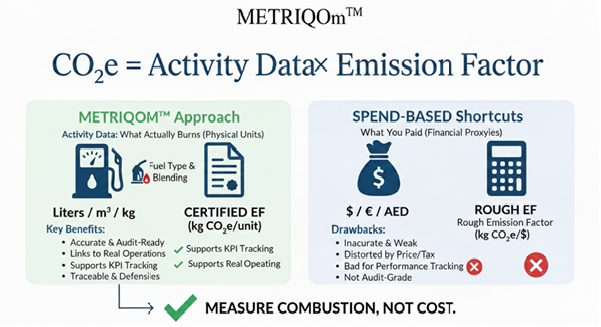
CO₂e = Activity Data × Emission Factor
That’s the core equation. What makes the difference is how we define activity data and emission factors – and this is exactly where METRIQOm®’s methodology is stronger, more scientific, and more globally comparable than many “quick” approaches.
- Our Core Principle: Measure the Real World, Not Just the Invoice
At METRIQOm®, for fuel combustion we use physical consumption as activity data:
- Litres of diesel
- m³ of natural gas
- Litres of petrol
- kg or tonnes of other fuels
Because what actually creates emissions is how much fuel is burned, not how much money was spent.
So, for a fuel-based source, the equation looks like:
CO₂e (kg or t) = Fuel Consumed (e.g. litres) × Emission Factor (e.g. kg CO₂e per litre)
This is a scientific, engineering-based approach: we link emissions directly to the combustion of the material and its carbon content, not to price fluctuations or tax structures.
- Why Fuel Consumption Is More Reliable Than Spend-Based Methods
Some databases and platforms use spend-based emission factors, for example:
kg CO₂e per currency unit (e.g. per AED, per USD)
This can be acceptable for high-level screening when you don’t have better data, but it has serious weaknesses if you want accurate, auditable GHG accounting:
- Taxes and subsidies distort the signal
- Two companies can burn the same amount of fuel but pay very different prices because of taxes, subsidies, or bulk discounts.
- A spend-based factor will give different emissions for the same physical activity – which is wrong from a technical standpoint.
- Market and supply-chain conditions vary by country
- Currency strength, inflation, and local logistics costs all influence prices.
- That means a “per spend” factor is only valid within the same country, time period, and similar supply-chain conditions. It is not robust when you compare sites, countries, or years.
- Not stable enough for long-term performance tracking
- If fuel prices double, a spend-based method will show higher “emissions” even if consumption stayed the same.
- That makes it useless for serious reduction tracking, target setting, or performance management.
Because of this, METRIQOm® deliberately avoids spend-based factors for fuel combustion in operational GHG accounting. We design our tools and dashboards to work with activity-based fuel data, which is what leading frameworks expect for Scope 1 and key Scope 2 sources.
- Emission Factors: Physical Units, Not Per-Spend
In METRIQOm®’s tools, emission factors (EFs) for fuel combustion are expressed in physical units, for example:
- kg CO₂e per litre of diesel
- kg CO₂e per m³ of natural gas
- kg CO₂e per kg or tonne of fuel
This is aligned with how emission factors are published in most recognised technical sources (e.g. IPCC Guidelines, national inventories, and many fuel-specific datasets), where EFs are based on energy content and carbon chemistry, not on financial spend.
This approach allows:
- Consistent application across countries
As long as the fuel specification is similar, the factor is valid, regardless of currency or tax regime. - Easy integration into engineering and operations
Operations teams already track litres, m³, tonnes. We plug directly into that data stream instead of forcing them into finance-based proxies. - Robust year-on-year comparison
If fuel use goes down, emissions go down – even if prices go up. That’s exactly the behaviour you want to see in a climate dashboard.
- Where Spend-Based Factors Belong: LCA Screening, Not Core GHG Accounting
Spend-based factors can have a role in Life Cycle Assessment (LCA) or Scope 3 screening, especially when:
- You have no physical data yet (e.g., early design stage, high-level spend only).
- You want to identify hotspots quickly in a large, complex value chain.
But even then, they are:
- Country- and context-specific: Because they embed local taxes, logistics, and technology mix, they cannot be safely transferred between countries or used for detailed benchmarking.
- A starting point, not the final answer: As soon as better activity data is available, good practice is to migrate away from spend-based and into volume/mass/energy-based factors.
That’s why METRIQOm®’s methodology clearly separates:
- Operational GHG accounting (corporate footprint, Scope 1 & 2) → Activity-based, fuel consumption
- Early-stage or high-level LCA screening → Spend-based only where necessary, and with clear caveats
- Why the METRIQOm® Method Is Aligned with Global Best Practice
METRIQOm® did not invent the equation CO₂e = Activity Data × Emission Factor – this is the backbone of modern GHG accounting. What we did is make sure our implementation is:
- Scientifically grounded – using physical units and combustion chemistry as the basis.
- Compatible with global standards – aligned with the way leading protocols and guidelines expect data to be structured (activity × EF).
- Practical for real operations – designed around fuel consumption records that companies already manage for cost, logistics, and safety reasons.
This means our clients can:
- Report emissions in a way that is auditable and credible.
- Upgrade easily to third-party verification or external assurance.
- Use the same dataset for KPIs, targets, and scenario analysis across years and across assets.
- The Business Advantage: Better Data, Better Decisions
Using a robust, activity-based methodology is not just a technical point; it creates real strategic value:
- Clear link between actions and outcomes
When you improve fuel efficiency or switch to lower-carbon fuels, the impact shows up immediately and reliably in the emissions. - Stronger case for investment
When you can quantify “litres saved” and “tonnes CO₂e reduced” with confidence, it becomes easier to justify CAPEX in efficient equipment, fleet renewal, or process optimisation. - Future-proof reporting
As regulators, stock exchanges, and investors demand more rigorous climate data, METRIQOm® clients are already using a methodology recognised worldwide and designed for external assurance.
- In Simple Terms
If we explain it in plain language:
- We don’t guess emissions from how much money you spent.
- We calculate emissions from how much fuel you actually burned.
- We then apply scientifically derived emission factors, expressed per litre, m³, kg, tonne, or kWh, to convert that into CO₂e.
That’s why we say: the METRIQOm® method is not just compliant – it is technically sound, globally recognized, and ready for serious climate strategy.