For many organizations, Life Cycle Assessment, or LCA, is where sustainability analysis starts. That makes sense. LCA is a strong foundation. It helps businesses understand the environmental impacts of a product, material, or system across the life cycle, from raw material extraction and manufacturing to transport, use, and end-of-life.
But the market is moving. Fast.
Today, companies are under pressure not only to understand environmental impact, but to act on it, reduce it, report it, prove it, and translate it into operational and strategic value. That is where the shift begins: from LCA as a standalone study to sustainability intelligence as a business capability.
LCA is the starting point, not the finish line
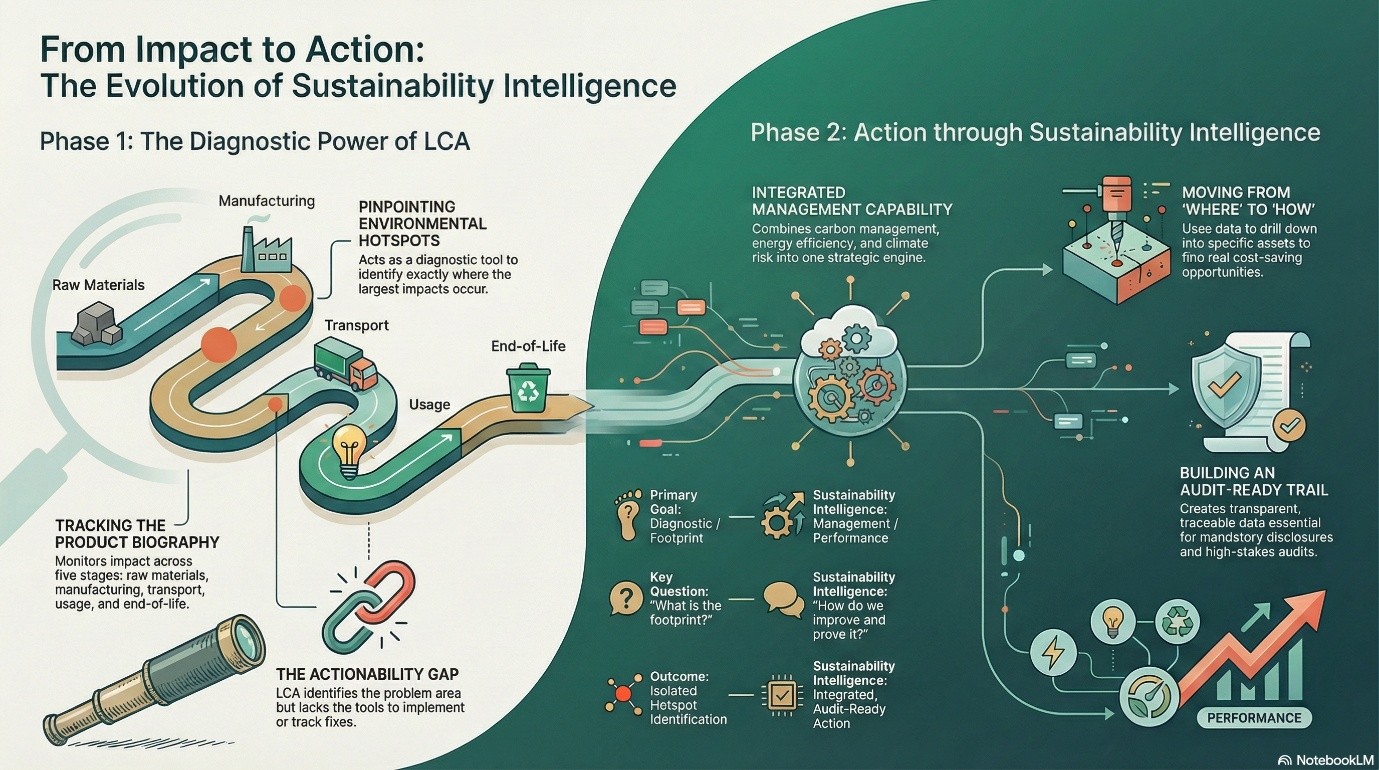
LCA plays an important role in identifying hotspots across the product life cycle. It can show where impacts are concentrated, where emissions are created, and where materials, logistics, or processes are driving environmental burden.
That is useful. But it is not enough on its own.
A product’s carbon footprint is not the whole story. Businesses also need to know:
- where the cost-saving opportunities sit
- which risks are operational versus strategic
- how to support decarbonization planning
- how to strengthen audit-readiness
- how to connect data to compliance and reporting obligations
- how to move from analysis to decision-making
In other words, LCA can reveal the issue, but it does not by itself run the management system.
The real business question is not just “What is the footprint?”
The stronger question is:
How do you fix the hotspot, save money, and prove it?
That is where many organizations get stuck. They may have technical assessments, consultant reports, spreadsheets, fragmented utility data, or one-off carbon studies. But they do not yet have a structured platform that turns sustainability data into recurring business intelligence.
That gap matters.
Without a controlled system, sustainability work often remains reactive, fragmented, and difficult to scale. Teams end up rebuilding the same datasets, chasing evidence, struggling with inconsistent assumptions, and preparing disclosures or audits under time pressure.
Why the next step is sustainability intelligence
The next maturity level is not more isolated studies. It is integration.
Businesses need a digital structure that connects LCA insights with the wider sustainability and operational agenda, including:
- energy efficiency
- GHG and carbon footprint management
- water performance
- environmental monitoring
- climate risk
- compliance tracking
- reporting readiness
This is where sustainability data becomes commercially useful. Instead of sitting inside reports, it starts informing decisions across operations, procurement, asset planning, risk management, and reporting.
From environmental data to actionable business intelligence
When sustainability data is connected properly, it can support several high-value outcomes at once.
First, it helps identify reduction levers more clearly. An organization can move beyond footprint visibility and start prioritizing actions with operational and financial relevance.
Second, it improves audit-readiness. Whether the driver is ISO 50001, internal governance, client requirements, ESG reporting, or future assurance demands, structured evidence and traceable logic become critical.
Third, it supports decarbonization planning. Companies cannot build credible transition plans if data remains disconnected across tools, departments, and reporting cycles.
Fourth, it improves reporting quality. Mandatory annual reporting, growing stakeholder scrutiny, and assurance expectations are pushing companies to strengthen data governance, not just disclosure drafting.
Sustainability data: obligation or opportunity?
For some organizations, sustainability data is still treated as a compliance burden. Something collected because a regulation, a client, or a tender requires it.
That mindset is too limited.
Used properly, sustainability data is a business opportunity. It can help reduce waste, lower energy cost, improve process visibility, strengthen market positioning, and support more resilient planning. It can also give management a clearer line of sight on where value leakage and environmental exposure are actually occurring.
That is the difference between reporting after the fact and managing performance in real time.
Why this matters now
The direction of travel is clear. Businesses are facing increasing pressure from regulators, investors, clients, supply chains, and internal leadership teams to produce better environmental data and more defensible sustainability claims.
The organizations that stay at the “static assessment” level will struggle to keep up.
The organizations that move toward integrated sustainability intelligence will be in a stronger position to:
- respond faster
- identify priorities sooner
- reduce risk more systematically
- support cost and carbon improvement together
- report with greater confidence
The practical shift businesses should make
The strategic move is simple:
Do not stop at footprint calculation.
Use LCA as a foundation, then connect it into a broader intelligence model that supports efficiency, decarbonization, compliance, risk management, and reporting.
That is how sustainability work becomes more than a technical exercise. It becomes part of how the business operates, improves, and competes.
How METRIQOm supports this shift
METRIQOm Intelligence is built around this exact transition: moving from isolated sustainability data to structured, actionable, audit-ready intelligence.
It helps organizations connect environmental and sustainability workflows across areas such as carbon accounting, energy efficiency, climate risk, water, environmental monitoring, compliance, and reporting. The objective is not just to measure impacts, but to turn data into decisions, controls, and practical business value.
Because the real question is no longer whether a company can calculate a footprint.
It is whether the company can use that information to act, improve performance, and prove progress.