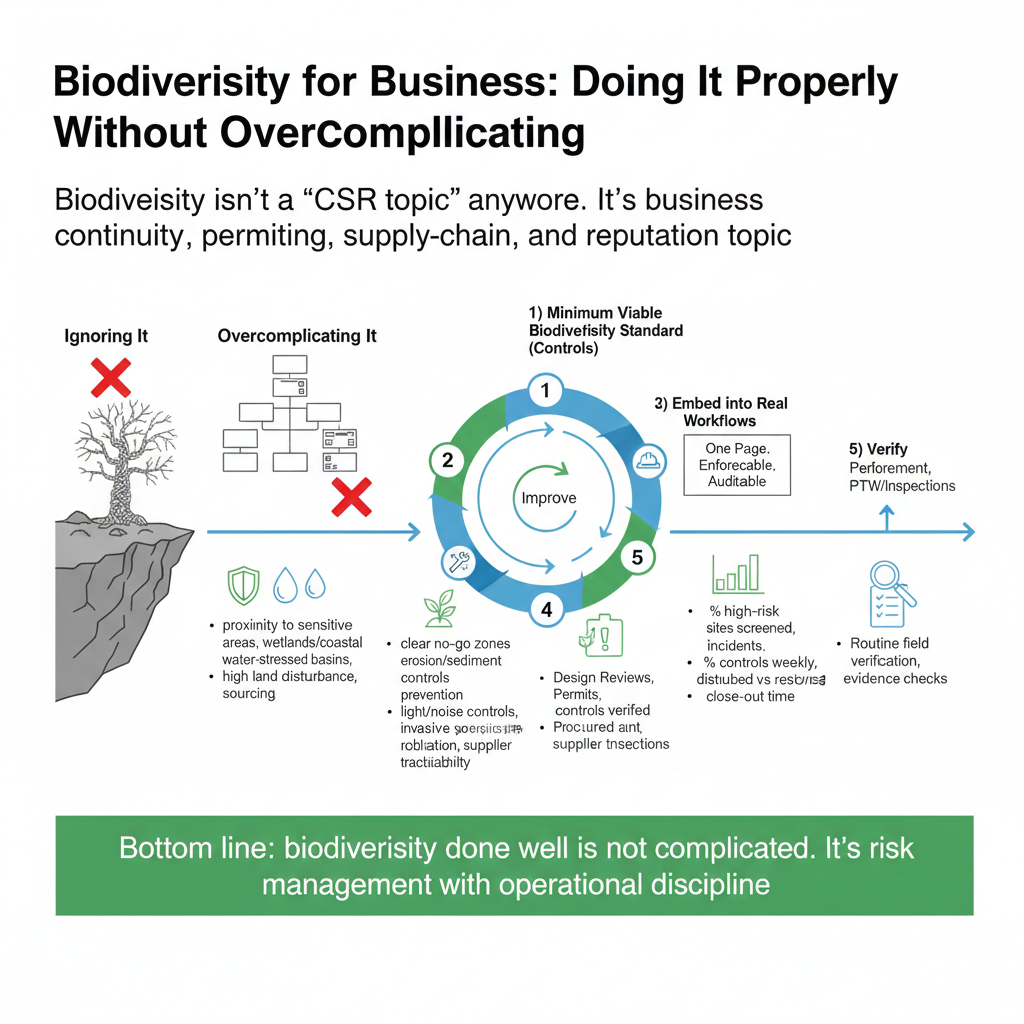
Biodiversity used to sit in the “nice to have” corner—something for CSR reports and awareness campaigns. That era is over.
Today, biodiversity is an operational risk, a supply-chain risk, a permitting risk, and increasingly a financing and reputational risk. But here’s the catch: many organisations overreact by building heavy frameworks that create documents, not outcomes.
You can do biodiversity properly without overcomplicating it—by treating it like any other business risk: identify what matters, control what you influence, measure what’s material, and verify performance.
What biodiversity means (in business language)
Biodiversity is not “saving animals.” It’s the health and resilience of the living systems your business depends on—soil, water, habitats, pollinators, coastal ecosystems, vegetation cover, and species networks.
If these systems degrade, your costs go up and your risk profile worsens:
- supply disruption (raw materials, agriculture inputs, water availability)
- asset exposure (flooding, erosion, coastal damage)
- compliance and permitting delays
- stakeholder opposition and brand impact
- insurance, finance, and investor scrutiny
The goal isn’t to become a conservation NGO.
The goal is to reduce nature-related risk and protect value.
Why companies get biodiversity wrong
Most failures fall into three patterns:
1) They start with reporting, not risk
They jump into indicators and disclosures before answering:
“Which parts of nature does our business affect and depend on?”
Without that, you end up measuring random metrics that don’t influence decisions.
2) They confuse ambition with execution
They publish commitments like “no net loss” or “nature positive” with no baseline, no scope boundaries, and no operational controls. That creates exposure, not credibility.
3) They overbuild the system
They create complex studies everywhere, all at once. The business gets fatigue, and biodiversity becomes a slow-moving compliance burden instead of a practical management tool.
The “do it properly” approach: simple, structured, and scalable
Here’s a practical model that works across construction, real estate, industrial sites, utilities, and supply chains.
Step 1 — Materiality first: focus on what matters
Start with two questions:
- Where do we depend on nature? (water, soil stability, coastal protection, pollination, temperature regulation)
- Where do we impact nature? (land take, habitat fragmentation, discharge, dust/noise/light disturbance, invasive species, sourcing)
Then rank your sites/operations by biodiversity sensitivity:
- proximity to protected areas or critical habitats
- wetlands/coastal zones/mangroves
- high groundwater dependence or water-stressed basins
- high land disturbance activities (excavation, dredging, quarrying)
- high-risk supply categories (timber, palm oil, seafood, beef/leather, aggregates)
Outcome: a risk-ranked biodiversity register, not a long report.
Step 2 — Build a “minimum viable biodiversity standard”
This is the best simplifier. Create a small set of non-negotiable controls that apply to relevant sites and suppliers.
Examples (adapt to your sector):
- no-go zones and clear demarcation for sensitive habitats
- erosion and sediment control (especially near water bodies)
- wastewater and runoff controls (prevent nutrient/silt load)
- light/noise management near sensitive receptors
- invasive species prevention plan (materials, landscaping, soil movement)
- vegetation management: avoid clearing during breeding periods (where relevant)
- restoration requirements after disturbance
- supplier requirements for high-risk materials (certification, traceability, legality)
Keep it short. Make it enforceable.
A one-page standard beats a 90-page strategy that nobody uses.
Step 3 — Make it real: embed controls into operations
Biodiversity should not live in a sustainability deck. It must live in:
- planning approvals and design reviews
- EIA/ESIA requirements and permit conditions
- procurement specs and supplier onboarding
- method statements and PTW for high-risk activities
- site inspections and contractor performance management
If biodiversity sits outside these workflows, it will fail.
Step 4 — Measure smart: a small KPI set that drives behaviour
You don’t need 50 indicators. You need a handful that management can act on.
A practical KPI pack:
- % of high-risk sites with biodiversity screening completed
- # of incidents/non-compliances (habitat disturbance, spills into soil/water, illegal clearing)
- % of sites with critical controls verified weekly (erosion control, runoff barriers, demarcation)
- Area disturbed vs area restored (hectares or m²)
- Native planting ratio (native vs ornamental, where landscaping is relevant)
- Supplier traceability coverage for high-risk materials (% of spend with evidence)
- Corrective action close-out time for biodiversity-related findings
These KPIs support execution and audit readiness.
Step 5 — Verify, don’t assume
This is the difference between credible and cosmetic.
Verification can be lightweight but consistent:
- biodiversity checks embedded into EHS inspections
- photo evidence for sensitive zones and controls
- periodic third-party spot checks for high-risk sites
- supplier document validation (not just collecting PDFs)
No verification = commitments become marketing claims.
What “good” looks like in practice
A business doing biodiversity properly will show:
- a clear biodiversity risk map (sites and supply chain)
- simple, enforceable standards embedded in operations
- a short KPI pack reviewed like any other performance area
- evidence and verification, not “we care” statements
- measurable reduction in incidents and improved permit outcomes
Don’t overcomplicate it: the 30–60 day rollout
If you want traction quickly:
Weeks 1–2
- shortlist high-risk sites/suppliers
- run screening and create a biodiversity risk register
- define your minimum viable biodiversity standard
Weeks 3–4
- embed controls into PTW/method statements and procurement
- train supervisors and procurement on “what to check”
- launch weekly verification on high-risk sites
Weeks 5–8
- track KPIs, close gaps, and tighten supplier evidence requirements
- publish a practical internal guidance note (not a glossy report)
This gets you real operational control without bureaucracy.
Bottom line
Biodiversity is not a side project. It’s a business risk and a value protection issue.
The winning approach is simple:
focus on material risks, standardise the controls, embed them into operations, measure what drives action, and verify performance.
That’s how you do biodiversity properly—without turning it into another complicated reporting machine.