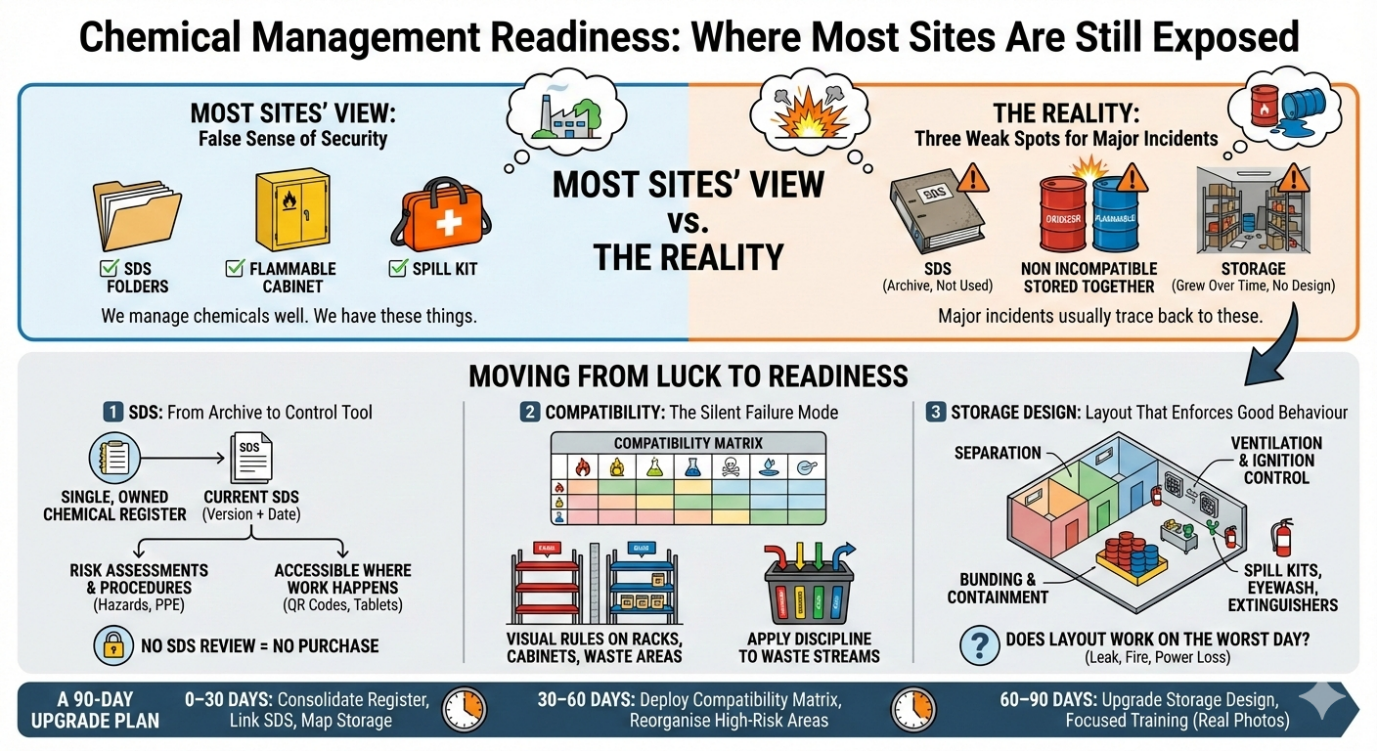
Chemical incidents rarely happen “out of the blue”. They’re almost always the end result of weak control over three basics:
- Safety Data Sheets (SDS)
- Chemical compatibility
- Storage design and housekeeping
If those three are under control, your chemical management is usually robust. If they’re not, you’re running on luck.
This blog unpacks how to move from reactive firefighting to a state of real chemical management readiness – where SDS control, compatibility, and storage design are integrated into daily operations, not treated as paperwork.
1. From “SDS on a Shelf” to SDS as a Living Control
Most sites technically have SDSs. Very few use them as an active risk control.
1.1 Build a single source of truth
Start with an SDS master register:
- One inventory, one owner
- Maintain a single chemical register covering all locations.
- Assign an accountable owner (e.g. Chemical Coordinator / QHSE Manager).
- Link every product to an SDS
- Product name, supplier, internal code
- SDS version/date, language, and validity period
- GHS classification and hazard statements (H-phrases)
- Control versions
- Flag SDS older than 5 years or superseded by the supplier.
- Keep old versions only for legal/audit tracing, not for daily use.
If you can’t answer in 30 seconds, “What chemicals do we have on site right now, and where are their SDSs?”, you’re not ready.
1.2 Make SDSs accessible at point of risk
SDSs locked in an office are compliance theatre.
- Digital access
- SDS library on intranet/tablet/QR code at storage and use areas.
- Folder structure by area or process (warehouse, lab, workshop, cleaning, maintenance).
- Critical info extracted
- Pull key SDS data into your risk assessments and procedures:
- Flammability, oxidizing, corrosive, toxic, sensitiser, etc.
- Incompatible substances and materials
- Required PPE and emergency actions
- Pull key SDS data into your risk assessments and procedures:
- Language and comprehension
- Provide SDSs and key instructions in languages your workforce actually understands.
- Translate the critical 10% (hazards, PPE, spills, first aid) into simple, visual instructions.
1.3 Embed SDS into the change and procurement process
SDS control has to start before the drum arrives.
- Pre-approval of new chemicals
- No purchase order without an SDS being reviewed.
- Screen for:
- Unnecessary high-hazard substances
- Substances banned or restricted by regulation
- Safer alternatives (substitution).
- Change management
- New or changed SDS = review of:
- Risk assessment
- Storage location and segregation
- Emergency response plan
- Waste handling routes
- New or changed SDS = review of:
This is where you stop “chemical creep” – the gradual build-up of unnecessary, incompatible, or legacy products.
2. Compatibility: The Hidden Weak Point in Many Sites
Most serious chemical events are not about how much you had, but what touched what.
2.1 Start with a compatibility matrix
You don’t need something fancy to be effective, but you do need something clear and enforced.
Typical compatibility groups:
- Flammables
- Oxidizers
- Acids (inorganic, organic if needed)
- Bases (alkalis)
- Toxic substances
- Reactive metals
- Water reactive
- Compressed gases
- Peroxides and strong oxidizing agents
For each group, define:
- Can be stored together? Yes / No / With strong controls
- Distance or physical barrier requirements
- Special notes (e.g. “Separate nitric acid from all organics”, “Keep hypochlorite away from acids”)
Then:
- Translate the matrix into simple visuals on the wall at chemical stores and labs.
- Use label colours or symbols on shelves and racks to reinforce it (e.g. red = flammables, yellow = oxidizers, blue = acids).
2.2 Don’t forget waste compatibility
Chemical waste is often treated as an afterthought – that’s a big risk.
- Apply compatibility rules to waste as strictly as to virgin chemicals.
- Separate waste streams: solvent waste, acid waste, alkaline waste, oily waste, heavy metal waste, etc.
- Clearly label waste containers with:
- Contents or process source
- Date started and responsible person
- Hazards (flammable, corrosive, toxic, etc.)
If you can’t quickly explain which wastes must never be mixed in the same drum, your compatibility control is weak.
3. Storage Design: Turning Rules into Real-World Controls
SDS control and compatibility matrices only work if the physical storage is designed to support them.
3.1 Get the basics right first
Think in layers of defence:
- Location
- Away from high-traffic office areas where possible
- Not blocking emergency exits, electrical distribution rooms, or escape routes
- Containment
- Bunds or spill pallets sized for the largest container (or 110% of largest container / 25% of total volume – depending on local guidance).
- No drains inside bunded areas unless they are controlled and go to a treatment system.
- Ventilation and ignition control
- Adequate ventilation for flammables and VOCs.
- No ignition sources (switches, heaters, battery chargers) inside the flammable storage zone unless rated.
- Flooring and protection
- Non-absorbent, easy-to-clean floors.
- Impact protection where forklifts operate near storage.
3.2 Align layout with compatibility rules
Your storage design should force correct behaviour, not rely on memory.
- Separate rooms or cabinets for major groups:
- Flammable store
- Acid cabinet
- Alkali cabinet
- General chemicals
- Inside each area, use:
- Clearly labelled sections and shelves
- Physical dividers between incompatible products
- Fixed locations for high-risk products and cylinders
If your site could “survive” a new contractor rearranging shelves over a weekend without creating incompatibilities, your design is robust.
3.3 Design storage with “worst day” in mind
Assume a leak, a fire, or power loss will happen at some point.
- Spill response ready at the point of use
- Absorbent materials, neutralisers (for acids/alkalis), overpack drums.
- Clear instructions: who to call, what to do, what NOT to do.
- Emergency showers and eyewash units
- Located within required distance of high-risk areas.
- Inspected and flushed regularly – with records.
- Fire protection
- Suitable extinguishers (e.g. foam for flammables, not water on reactive metals).
- Clear “do not use water” zones where appropriate.
- Signage
- GHS symbols at room doors and on cabinets.
- No smoking, no ignition sources, PPE requirements.
4. Readiness Is More Than Compliance – It’s Capability
You can have a full SDS library, pretty labels, and a neat store, and still not be ready.
Chemical management readiness is about capability under stress:
- Can the operator in the night shift respond correctly to a spill without asking “Where’s the SDS?”
- Can the supervisor decide whether two substances are safe to store side-by-side in seconds?
- Can the site leadership explain, at audit or after an incident, why chemicals are organised the way they are?
4.1 Build a simple readiness scorecard
Move beyond “yes/no” compliance:
Assess maturity across a few dimensions:
- SDS Control
- Ad-hoc / Partial / Systematic / Integrated
- Compatibility Management
- No formal rules / Rules on paper only / Visible rules / Rules embedded into layout and training
- Storage Design
- Organic growth / Basic controls / Designed by risk / Periodically reviewed and stress-tested
- Training & Behaviour
- One-off toolbox / Basic annual training / Role-based training / Behaviour and near-miss data driving improvements
Target: move each area at least one maturity level up over the next 6–12 months.
5. Practical Actions for the Next 90 Days
Turn the concept into a short, aggressive action plan.
Within 30 days
- Consolidate a single chemical register and link all chemicals to current SDSs.
- Identify and flag:
- Missing SDSs
- Out-of-date SDSs
- Unknown or duplicate products.
- Map where chemicals are stored today (rough sketch is enough).
Within 60 days
- Implement a basic compatibility matrix and translate it into:
- Labelling of storage areas
- Simple wall posters
- Reorganise high-risk areas based on compatibility rules (flammables vs oxidisers vs acids vs bases).
- Review waste streams and separate clearly incompatible wastes.
Within 90 days
- Upgrade storage design for at least your top-risk area:
- Add/upgrade bunding and spill pallets.
- Improve ventilation and signage.
- Position spill kits, eyewash, extinguishers where they’re actually needed.
- Run targeted training sessions for supervisors and operators using real site photos and near-misses.
- Introduce a chemical management readiness checklist for monthly walk-downs.
6. Looking Forward: Chemical Readiness as Part of ESG and Operational Excellence
Chemical management is not just a safety line item. It sits at the intersection of:
- Safety & Health – preventing exposures, burns, fires, and acute incidents.
- Environment – controlling spills, emissions, and hazardous waste.
- Compliance & ESG – meeting REACH/CLP/GHS/local regulations and demonstrating responsible operations.
- Operational continuity – avoiding disruption from incidents, enforcement actions, and reputational damage.
A mature chemical management system – with controlled SDSs, enforced compatibility, and intelligent storage design – is a visible signal that the site is disciplined, risk-aware, and future-ready.
LinkedIn version
Chemical Management Readiness: Where Most Sites Are Still Exposed
Most sites think they manage chemicals well because they have SDS folders, a flammable cabinet, and a spill kit.
In reality, major incidents usually trace back to three weak spots:
- SDS that exist but are not used as a live control
- Poor compatibility management (what’s stored next to what)
- Storage areas that “grew over time” instead of being designed
If these three aren’t tight, you’re relying on luck.
1️⃣ SDS: From Archive to Control Tool
Readiness starts with a single, owned chemical register:
- Every product linked to a current SDS (version + date)
- Key hazards and PPE pulled into risk assessments and procedures
- SDS accessible where work happens (QR codes / tablets in storage and use areas)
No SDS review = no purchase. New or updated SDS = trigger to review risks, storage, emergency response, and waste.
2️⃣ Compatibility: The Silent Failure Mode
Most serious events are about incompatibles meeting, not “too much volume”.
- Use a simple compatibility matrix: flammables, oxidizers, acids, bases, toxics, water-reactives, gases, etc.
- Turn it into visual rules on racks, cabinets, and waste areas – not just a PDF in a folder.
- Apply the same discipline to waste streams, not only virgin products.
If a contractor can “rearrange the shelves” without creating a risk, your system is mature.
3️⃣ Storage Design: Layout That Enforces Good Behaviour
Well-designed storage turns rules into default behaviour:
- Bunding and containment sized for worst-case
- Separation of flammables, acids, bases, and general chemicals
- Ventilation and ignition control where flammables and VOCs are stored
- Spill kits, eyewash, and extinguishers at point of risk
Ask yourself: does our layout still work on the worst day – during a leak, fire, or power loss?
A 90-Day Upgrade Plan
You don’t need a multi-year program to move the needle:
- 0–30 days: consolidate one chemical register, link all SDS, map current storage.
- 30–60 days: deploy a basic compatibility matrix and reorganise high-risk areas.
- 60–90 days: upgrade storage design for your top-risk store and run focused training using real site photos.