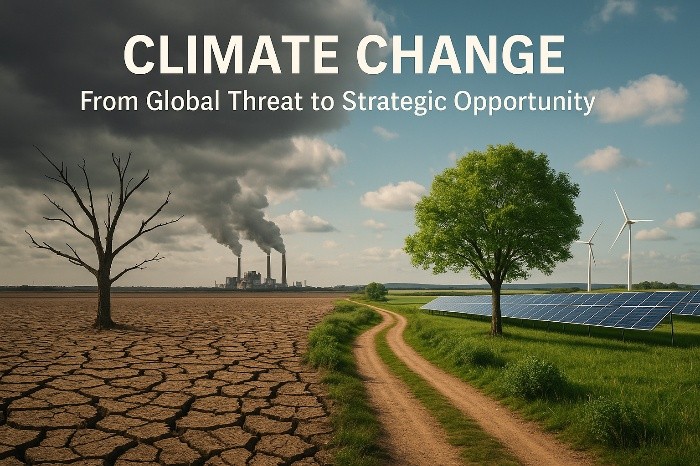
For decades, climate change has been framed almost exclusively as a global threat—an environmental crisis driven by rising temperatures, extreme weather, and ecological disruption. That framing is accurate, but incomplete. For forward-looking organizations, climate change is no longer just a risk to be mitigated; it is a strategic inflection point reshaping markets, regulation, capital flows, and competitive advantage.
From External Risk to Core Business Issue
Climate impacts are now operational realities. Heat stress affects productivity. Flooding disrupts supply chains. Energy volatility challenges cost predictability. What was once considered an external environmental issue has moved squarely into boardroom territory, demanding the same rigor as financial, operational, and safety risks.
Organizations that still treat climate change as a compliance topic are already behind. Leaders are embedding climate risk into enterprise risk management, capital planning, and long-term strategy—recognizing that physical and transition risks directly influence profitability and resilience.
Regulation Is Raising the Strategic Bar
Governments and regulators worldwide are accelerating climate-related requirements—on emissions, energy efficiency, disclosure, and adaptation planning. This is not a temporary wave. It represents a structural shift toward low-carbon, transparent, and accountable business models.
The strategic opportunity lies in anticipation. Companies that align early—rather than react late—reduce compliance costs, avoid stranded assets, and gain credibility with regulators and stakeholders. Climate readiness is fast becoming a prerequisite for market access, not an optional add-on.
Capital Is Flowing Toward Climate-Ready Businesses
Investors are increasingly differentiating between climate-exposed and climate-resilient organizations. Access to capital, insurance terms, and valuation multiples are now influenced by climate governance, transition planning, and performance metrics.
This creates a clear opportunity: organizations that demonstrate credible climate strategies can attract investment, lower financing costs, and strengthen long-term valuation. Climate action, when done strategically, becomes a lever for financial resilience rather than a cost burden.
Innovation and Efficiency as Competitive Advantages
Climate strategy drives innovation. Energy efficiency reduces operating costs. Renewable integration improves energy security. Process optimization cuts waste, emissions, and inefficiencies simultaneously.
Many organizations discover that climate initiatives unlock hidden value—leaner operations, smarter asset use, and more resilient supply chains. The result is not just lower emissions, but stronger operational performance in a volatile global context.
From Net Zero Pledges to Execution Discipline
Public commitments alone are no longer sufficient. Stakeholders are demanding execution: clear baselines, realistic pathways, interim targets, and measurable outcomes. Organizations that translate ambition into structured roadmaps—linked to capital planning and operational decision-making—stand out from those relying on generic promises.
This shift rewards discipline. Climate strategy becomes an operational management exercise, not a communications campaign.
Building Long-Term Resilience
At its core, climate strategy is about future-proofing. Organizations that understand their climate exposure, adapt assets and processes, and transition toward low-carbon models are better positioned to withstand shocks—whether environmental, regulatory, or economic.
Resilience is no longer defined by size or scale, but by adaptability.
Strategic Takeaway
Climate change is redefining how value is created and protected. Organizations that approach it defensively will focus on damage control. Those that approach it strategically will use it to drive innovation, strengthen governance, attract capital, and build durable competitive advantage.
The question is no longer whether climate change will affect your business. It is whether your organization will treat it as a constraint—or as a catalyst for smarter, more resilient growth.