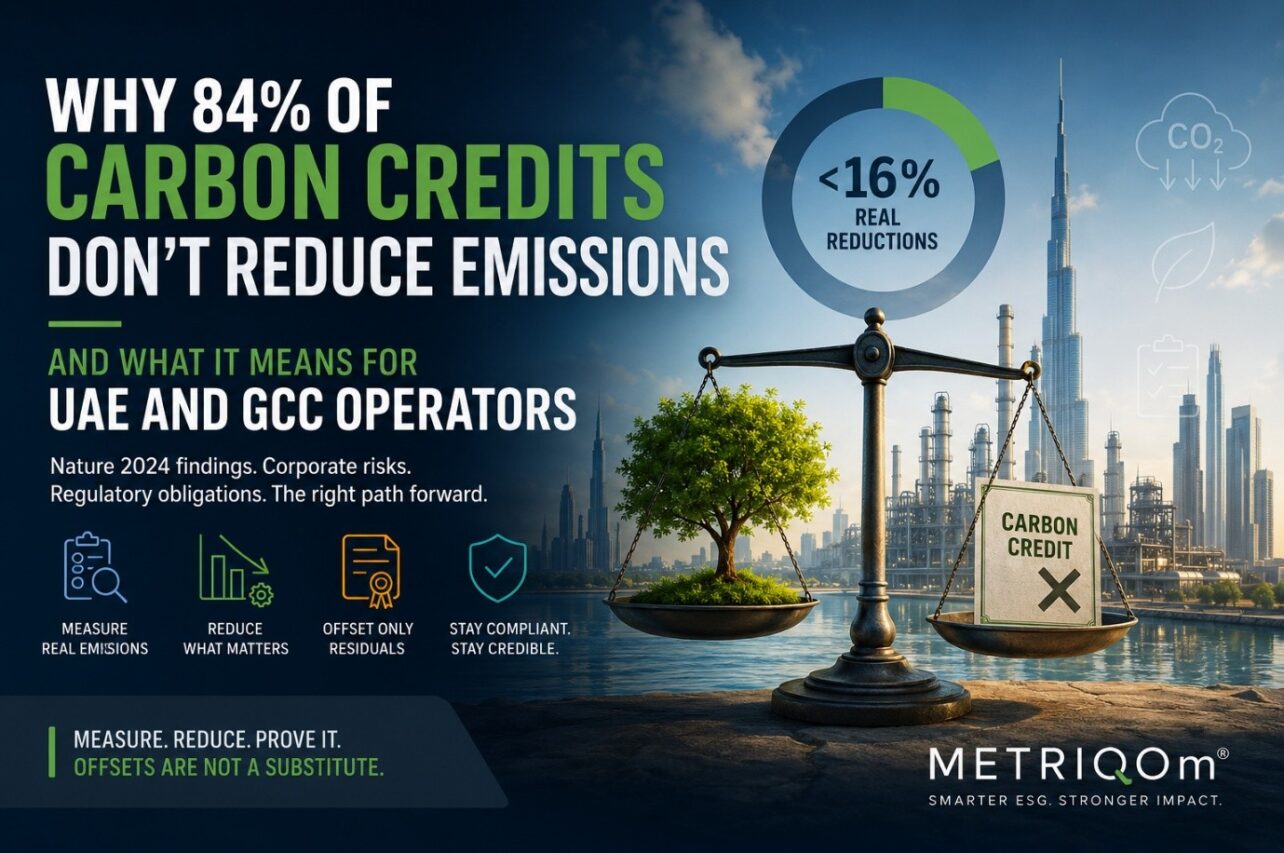
The UAE climate compliance deadline is changing the conversation.
With the 30 May 2026 adjustment window linked to Federal Decree-Law No. 11 of 2024 approaching, many operators are looking for the fastest route to show climate action. For some companies, the shortcut may look simple: buy carbon offsets, retire credits, and declare “carbon neutral.”
That approach is risky.
The issue is not that every carbon credit is useless. The issue is that carbon credits are often used as a substitute for real measurement, real reduction, and real operational control. That is where the compliance, audit, and reputational risk begins.
The evidence is now too strong to ignore
A major piece of research in Nature Communications analysed 2,346 carbon crediting projects across multiple project types. The study covered almost 1 billion tonnes of CO₂e in issued credits and found that less than 16% of the credits represented real emission reductions. The project-type results were even more concerning: 11% for cookstoves, 16% for SF₆ destruction, 25% for avoided deforestation, and 68% for HFC-23 abatement. The study also found no statistically significant emission reductions from wind power and improved forest management projects. (MPG)
This means the headline problem is simple:
A certificate may exist.
A credit may be retired.
But the atmosphere may not receive the reduction being claimed.
That distinction matters for any company using offsets to support ESG claims, net-zero claims, tender submissions, sustainability reports, or client-facing carbon neutrality statements.
Corporate buyers are exposed too
The problem is not limited to project developers. It also affects corporate buyers.
A 2024 follow-up study examined the top 20 corporate buyers of voluntary carbon offsets between 2020 and 2023. It found that 87% of the offsets carried a high risk of not delivering real and additional emission reductions, with many credits linked to forest conservation and renewable energy project types. (Nature)
That creates a serious business risk.
Companies may think they are buying climate credibility, but they may actually be buying a future audit question:
What did you really reduce?
Where is the activity data?
Where is the baseline?
Where is the evidence?
Was the credit additional, permanent, verified, and not double counted?
If those questions cannot be answered, the offset becomes a reputational liability, not a sustainability solution.
The investigative journalism layer made this public
The carbon market issue also moved from technical research into mainstream media. In 2023, The Guardian, Die Zeit, and SourceMaterial investigated rainforest carbon credits linked to Verra. Their analysis argued that a very high share of the assessed rainforest credits were likely not delivering the claimed climate value, and the article named major corporate buyers including Disney, Shell, Gucci, United Airlines, Air France, Samsung, Netflix, and Chevron. Verra strongly disputed the findings and argued that the analysis relied on methods that did not properly account for project-specific deforestation risks. (The Guardian)
That disagreement is important.
It shows that carbon credits are not only a technical accounting issue. They are also a governance issue, a methodology issue, a reputational issue, and a legal-claims issue.
What this means for UAE and GCC operators
For UAE and GCC companies, the lesson is direct:
Offsets are not the compliance foundation.
Measurement is the compliance foundation.
Under UAE Federal Decree-Law No. 11 of 2024, the core requirement is measurement, reporting, verification, emissions inventory preparation, periodic reporting, reduction measures, and retention of measured emissions records for five years. Article 6 requires sources determined by the Ministry and competent authority to measure emissions regularly, prepare an emissions inventory, submit periodic reports, provide activity data and reduction-measure information, and maintain measured emissions records.
The law recognises carbon offsetting as one possible mitigation action, but it does not make offsets a replacement for emissions measurement. Carbon offsetting is listed as one mitigation method alongside other actions such as improving energy efficiency, implementing clean technologies, using alternatives to fluorocarbons, and integrated waste management.
Cabinet Resolution No. 67 of 2024 also regulates the National Register for Carbon Credits, including high-emitting entities and participating entities, but this sits on top of monitoring, reporting, and verification requirements. It is not a licence to skip Scope 1 and Scope 2 measurement. (UAE Legislation)
So the operational message is clear:
Buying credits before building a verified emissions inventory is putting the roof before the foundation.
The compliance risk: confusing offsets with reductions
A UAE or GCC operator may buy offsets and still have weak climate compliance if it cannot prove:
- diesel consumed by fleet, generators, and equipment;
- electricity consumption by site, asset, or facility;
- refrigerant leakage and fugitive emissions;
- process emissions where applicable;
- purchased materials and major Scope 3 sources;
- waste treatment routes;
- water and wastewater-related operational impacts;
- supplier and contractor emissions where relevant;
- emission factors, calculation methods, approvals, and evidence trail.
A retired credit certificate does not answer these questions.
It may support a voluntary climate contribution or residual-emissions strategy, but it does not replace operational carbon accounting.
The better hierarchy: measure, reduce, then offset residual emissions
Companies need a stronger carbon-management hierarchy:
1. Measure the baseline
Start with real activity data: litres of diesel, kWh of electricity, refrigerant top-ups, tonnes of materials, transport distances, waste quantities, and supplier data.
2. Build an auditable GHG inventory
Apply clear emission factors, calculation logic, scopes, boundaries, data-quality checks, and evidence records.
3. Reduce emissions inside the operation
Prioritise energy efficiency, fuel reduction, electrification, renewable energy, leak prevention, low-carbon procurement, logistics optimisation, and process controls.
4. Use offsets only for residual emissions
Offsets should come after reduction, not before it. They should be screened for additionality, permanence, leakage, double counting, registry integrity, vintage, methodology, and third-party verification.
5. Be careful with claims
“Carbon neutral” and “net zero” claims need strong evidence. Weak offsets can quickly become greenwashing exposure.
How METRIQOm® addresses this problem
METRIQOm® is built around the principle that carbon management must start with controlled source data, not marketing claims.
The GHG & Carbon Footprint module supports activity-data-based Scope 1, Scope 2, and relevant Scope 3 inventory development. It aligns with ISO 14064-style accounting logic, supports emissions-factor libraries, keeps calculation transparency, and links results back to the original evidence trail.
For UAE operators, this is critical because the expected regulatory direction is not just “show climate ambition.” It is:
measure emissions, report emissions, verify data, retain records, and demonstrate reduction action.
METRIQOm® helps operators move from scattered spreadsheets and retired credit certificates to a controlled emissions-management system with:
- site-level and entity-level GHG inventories;
- Scope 1, Scope 2, and Scope 3 categorisation;
- source-data evidence tracking;
- emission-factor governance;
- calculation audit trail;
- QA/QC checks;
- reduction-action tracking;
- dashboard reporting;
- readiness for MRV and assurance workflows;
- AI-supported evidence review and data consistency checks.
The output is what regulators, auditors, investors, clients, and boards increasingly need:
real measurements, clear methodology, traceable evidence, and a reduction plan that can be defended.
Final message
Carbon credits may still have a role in climate finance.
But they are not a shortcut to compliance.
They are not a substitute for Scope 1, Scope 2, and Scope 3 measurement.
They are not a replacement for energy efficiency, fuel reduction, electrification, procurement improvement, and operational decarbonisation.
And they are definitely not strong enough to carry a carbon-neutrality claim without a verified emissions baseline behind them.
For UAE and GCC operators, the winning approach is not to buy climate credibility.
It is to build it.
Measure first.
Reduce first.
Use offsets carefully for residual emissions only.
And make sure every claim can survive audit.Book a demo of METRIQOm® or explore the GHG & Carbon Footprint module to build an audit-ready emissions inventory before relying on offsets.