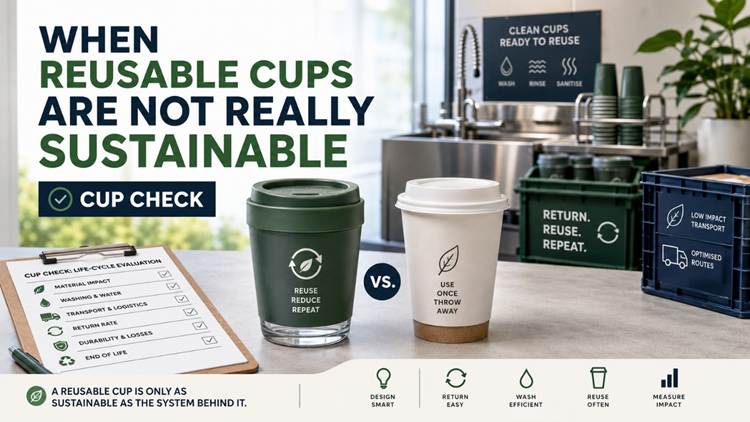
For many, the morning ritual of handing over a sleek, double-walled stainless steel tumbler to a barista is a badge of environmental honor. It feels like a definitive victory over the tide of single-use waste. However, as an analyst looking at the Life Cycle Assessment (LCA) of these products, I see a more complex narrative: the “Sustainability Paradox.” This paradox occurs when the very items designed to save the planet end up placing a heavier burden on our ecosystems than the disposables they replace. To move beyond the “green” feel-good factor, we must reconcile our consumption habits with the hard data of resource management.
Reusable Is Not a Guarantee of Sustainability
The label “reusable” is a statement of potential, not a declaration of impact. From a systems perspective, sustainability is not an inherent property of an object; it is a variable of the object’s entire lifecycle. If a reusable cup is manufactured using high-energy processes but is only utilized a dozen times before being relegated to the back of a cupboard, its environmental performance is actually inferior to a standard polyethylene-lined paper cup.
Manufacturing a durable alternative—whether it’s ceramic, glass, or stainless steel—requires significantly more raw material extraction and caloric energy than a thin sleeve of wood pulp. When we treat reusables as fashion accessories rather than long-term utility tools, we undermine the environmental logic of the product. Reusability only yields a dividend if the consumer commits to a high volume of use that offsets the “upfront” carbon cost.
The Hidden Footprint of Reusable Cups
Every reusable item arrives on the shelf with a significant “Ecological Debt.” Before a drop of coffee ever touches the vessel, the environment has already paid a price in water consumption, mining, and manufacturing emissions. This is what we call the “embodied energy” of the product.
“The Hidden Footprint of Reusable Cups”
To justify this footprint, a cup must reach a “break-even point.” For a ceramic mug, the LCA data suggests you may need to use it between 15 and 50 times to match the carbon footprint of a single-use paper cup. However, for more resource-intensive materials like stainless steel or specialized plastics, that break-even point can skyrocket to several hundred uses. If your “eco-friendly” purchase doesn’t survive long enough—or isn’t used frequently enough—to reach that threshold, you haven’t helped the environment; you’ve simply increased your personal carbon intensity.
It’s Only Better When Managed Properly
Sustainability is a systemic challenge, not a retail choice. The net impact of a reusable cup is dictated by the infrastructure of your daily life. We must look past the product and “Check the System” to ensure our habits aren’t counterproductive.
- Maintenance Efficiency: The energy intensity of your cleaning habit is a critical variable. If you run a dishwasher on a high-heat cycle for a single cup, or leave the tap running hot water for several minutes to rinse it, the grid energy required for water heating can quickly obliterate any carbon savings gained by avoiding a disposable cup.
- Systemic Utility: Consider the end-of-life infrastructure. Many modern reusable cups are “multi-material” products, featuring stainless steel bodies, silicone seals, and BPA-free plastic lids. While durable, these composite items are notoriously difficult to recycle. Unlike a simple paper cup, a broken or unwanted “eco-cup” often ends up in a landfill because our current systems cannot efficiently separate these bonded materials.
When Reusable Cups Are Not Actually Sustainable
There is a point where the “green” choice becomes a net negative. If a consumer maintains a “cupboard graveyard” of various reusable vessels, the cumulative embodied carbon of those unused items far exceeds the impact of occasional single-use consumption. Furthermore, in water-stressed regions or areas where the energy grid is heavily reliant on coal, the recurring environmental cost of washing a reusable cup with hot water can be higher than the one-time cost of producing and disposing of a paper alternative. A true “Reality Check” requires us to admit that if we aren’t going to use a cup hundreds of times and wash it efficiently, the disposable option may—counter-intuitively—be the lesser of two evils.
Conclusion: Rethinking the Switch
The transition to reusables is a necessary evolution, but it must be driven by data rather than dopamine hits from a new purchase. We must shift our focus from the act of buying green to the discipline of living green. Before you acquire your next reusable alternative, ask yourself: Have I used my current cup enough to pay back its ecological debt? Genuine sustainability isn’t found in the product you buy; it’s found in the systems you optimize and the items you refuse to replace.
Reusable Cups Need a Reality Check