 METRIQOm®
Why Pressure Is an Illusion: 5 Counter-Intuitive Truths About Industrial Compressed Air and Climate Risk
1. Introduction: The Hidden Factory Hazard
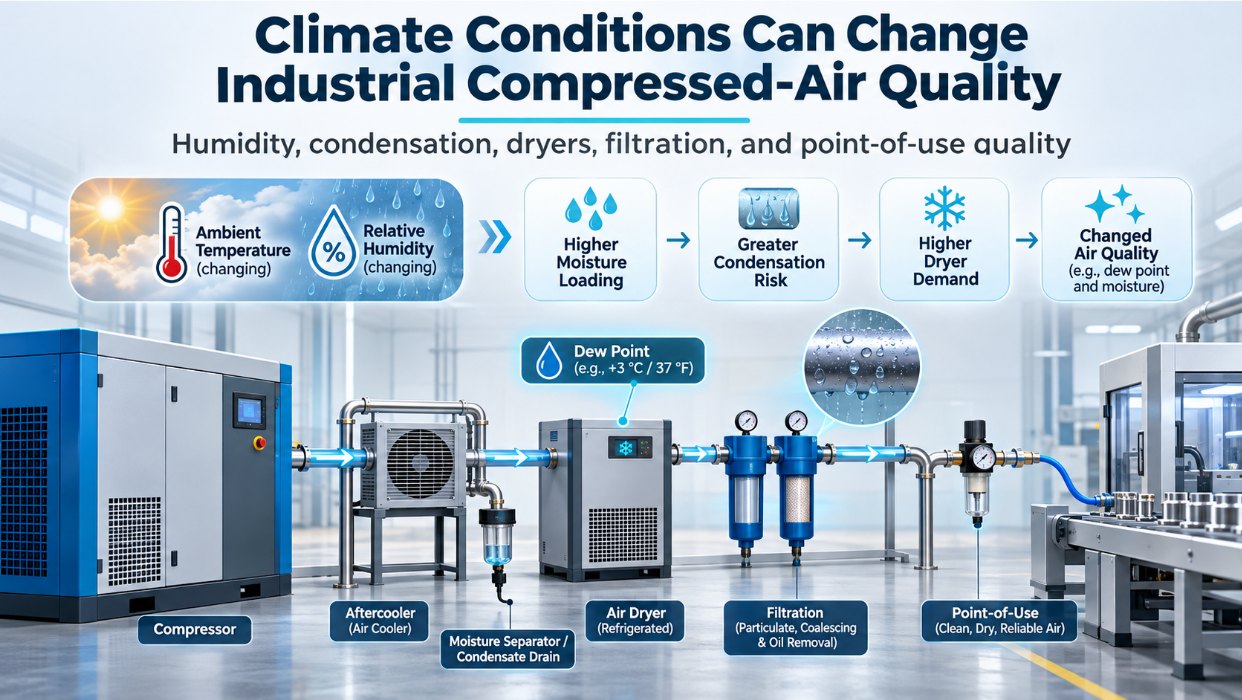
For plant managers, operations leaders, and manufacturing engineers, a steady pressure gauge in the compressor room offers a comforting sense of control. However, that static reading can be dangerously deceptive. While your central header gauges show optimal line pressure, shifting ambient weather—specifically rising temperatures and relative humidity—may be secretly sabotaging your downstream product quality and process control.
The core problem stems from a common operational blind spot: line pressure and volumetric flow rate do not equal air purity or system reliability. Compressed air powers critical automation, pneumatic instrumentation, industrial coatings, packaging lines, and precision equipment across your facility. When ambient climate shifts increase moisture loading on your system, relying strictly on central pressure readings leaves your most sensitive production assets completely unprotected.
To safeguard production integrity, industrial facilities must establish an end-to-end operational control chain:
Ambient Conditions → Moisture Load → Cooling & Separation → Drying → Distribution → Point-of-Use Verification → Corrective Action
2. Takeaway 1: Operating Pressure Does Not Guarantee Air Quality (The Static Gauge Fallacy)
Relying solely on historical pressure readings creates a false sense of operational security. Because warmer ambient air possesses an exponentially higher water-vapour holding capacity, seasonal temperature spikes sharply increase the mass moisture loading at the compressor inlet. This thermal overloading overburdens aftercoolers, desiccant or refrigerated dryers, moisture separators, and automated drainage systems, triggering liquid carryover even while line pressure holds steady.
To mitigate this operational risk, engineering teams must evaluate air purity against established international standards rather than relying on historical design assumptions. The ISO 8573-1:2010 standard explicitly classifies compressed-air purity across three distinct contaminant categories: solid particles, water, and oil. Rather than applying a blanket air-quality assumption across an entire plant, purity classes must be defined by the specific process sensitivity of individual equipment connections.
Operating under unverified historical assumptions is a dangerous trap for modern precision manufacturing. Facilities that monitor electrical energy consumption and system pressure while ignoring dynamic inlet moisture loading expose their assets to silent, cumulative degradation.
The risk is that production continues while corrosion, pneumatic failures, coating defects, and product-quality problems develop.
3. Takeaway 2: Coalescing Filters Do Not Dry Your Air (The Liquid vs. Vapour Trap)
A widespread technical misconception in plant engineering is that high-efficiency filtration resolves downstream moisture issues. In physical reality, there is a strict mechanical distinction between entrained liquid removal and water-vapour control. Coalescing filtration is engineered exclusively to capture micro-droplets and entrained liquid aerosols, but it cannot lower water-vapour concentration or suppress dew points.
Technical guidance from the Compressed Air & Gas Institute (CAGI) stresses the necessity of treating moisture management as a multi-stage process. CAGI outlines distinct, non-interchangeable roles for mechanical moisture separation, aerosol filtration, and vaporous air drying within a complete air-treatment architecture.
Confusing liquid separation with vapour control leads to unexpected downstream condensation. As warm air travels away from the compressor room, distribution cooling losses cause heat to dissipate through pipework walls, forcing unchecked water vapour to condense directly into liquid water. To avoid over-specifying dew points factory-wide—which drives up capital expenditure and parasitic energy consumption—facilities should establish targeted point-of-use Pressure Dew Point (PDP) specifications rather than over-treating the entire facility distribution network.
4. Takeaway 3: Compressor Outlet Readings Lie About Point-of-Use Quality (Distribution Line Losses)
Centralized air-quality measurements taken at the compressor room receiver or main header fail to reflect actual air purity at critical point-of-use connections. Air quality degrades dynamically as compressed air travels through the distribution network, encountering thermal variations, pressure drops, and localized pipework contamination.
To protect sensitive pneumatic tools and automated processes, engineering teams must verify Pressure Dew Point (PDP)—the temperature at which water vapour condenses into liquid at operating pressure—directly at critical production connections rather than trusting supply header output.
Key variables actively alter air purity along the distribution network:
- Downstream cooling and seasonal pipework exposure
- Distribution low points and pressure drops
- Point-of-Use process sensitivity
5. Takeaway 4: Effective Control Requires a 4-State Escalation Framework
Transitioning from reactive maintenance to proactive risk management requires a structured condition-based monitoring (CBM) model. Facilities must track key operational parameters, including ambient dry-bulb temperature and humidity, system airflow, operating pressure, point-of-use PDP, dryer thermal performance, condensate drainage execution, and filter differential pressure.
A robust operational control framework categorizes system health into four actionable states:
- GREEN: Verified air quality meets approved specifications.
- AMBER: Performance margins narrow; investigate and increase monitoring.
- RED: Required limits are exceeded; restrict affected applications and initiate corrective action.
- BLACK: Required air quality cannot be assured for critical operations; suspend affected use until compliance is verified and restart is authorized.
Assigning explicit operational responses to these states prevents catastrophic product contamination. For instance, shifting from AMBER to RED triggers physical flow restriction or process bypass, whereas escalating to BLACK initiates automated or manual valve isolation at critical point-of-use connections.
6. Takeaway 5: Air Quality is a Leadership & Production Decision—Not Just Maintenance
Ensuring compressed-air quality requires a coordinated cross-functional control chain rather than delegating moisture control entirely to facility maintenance personnel. Sustained climate resilience demands formal governance and clear cross-departmental accountability across four key operational areas:
- Engineering: Verifies total air-treatment capacity under peak summer moisture loading, utilizing ISO 7183:2007 test standards to evaluate dryer flow capacity, PDP suppression, pressure drop performance, air losses, and overall power consumption.
- Maintenance: Sustains equipment health across dryers, automatic condensate drains, moisture separators, and inline filtration assemblies.
- Quality: Establishes application-specific acceptance criteria, process contamination thresholds, and minimum required dew-point limits.
- Operations: Enforces immediate operational discipline when system parameters breach RED or BLACK monitoring thresholds.
Compressed-air quality is a production-control requirement, not merely a maintenance responsibility.
7. Conclusion: Beyond Historical Assumptions
Achieving true climate resilience in modern industrial operations requires moving beyond historical design assumptions. Facilities must integrate dynamic environmental monitoring, physical asset inspections, continuous PDP tracking, and formal operational escalation protocols into their core asset management strategy.
Integrated operational control systems like METRIQOm® support this proactive approach by linking environmental monitoring, asset condition, inspection evidence, corrective actions, and management review into a unified, audit-ready compliance framework. By connecting ambient climate realities directly with asset governance, manufacturers ensure their compressed-air systems reliably deliver compliant air under peak operational conditions.
Is your compressed-air system verified against changing temperature and humidity conditions—or are you still relying on historical design assumptions?