 METRIQOm®
Why Full Granaries Can Still Leave Us Undernourished: The Hidden Quality Crisis in Climate-Era Farming
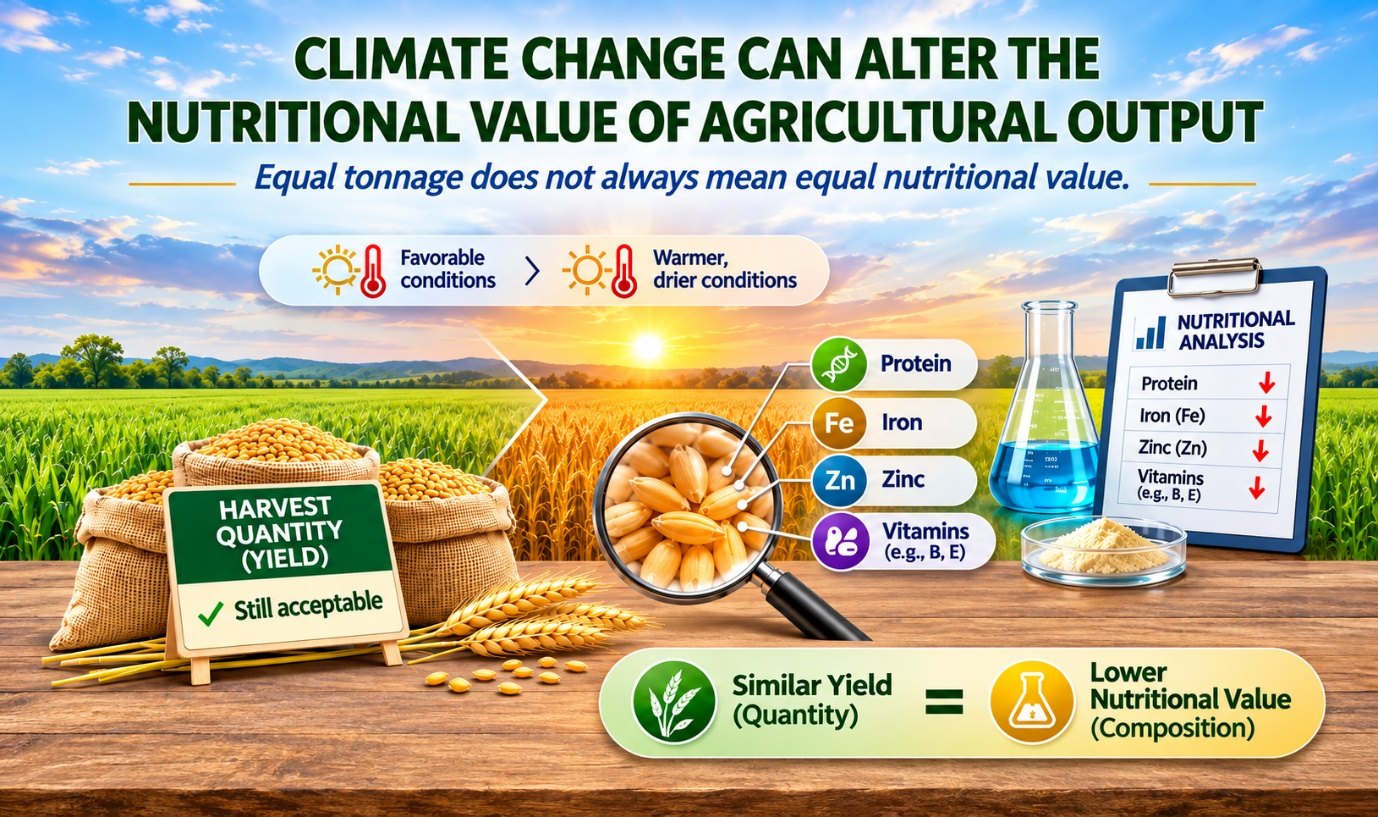
Modern agriculture is running into a silent wall: our traditional metrics measure volume, but biology measures concentration. A field of wheat can hit every tonnage target, pass visual grading with high marks, and fill silos to capacity—yet mask a critical decline in internal quality.
This disconnect exposes the invisible paradox of climate-era farming. Maintaining crop yields in tonnes per hectare no longer guarantees nutritional integrity, leaving food systems vulnerable to an unseen deficit.
Elevated Carbon Dioxide is Secretly Diluting Key Nutrients
Atmospheric carbon dioxide levels are reshaping plant biology from the inside out through a process known as nutrient dilution. As elevated CO₂ accelerates photosynthesis, crops accumulate higher proportions of carbohydrates. However, this starch accumulation dilutes essential mineral and protein concentrations, keeping physical output stable while quietly diminishing nutritional density. Beyond atmospheric carbon, interlinked drivers—including heat stress, shifting soil moisture, and altered nutrient uptake—interact with growth stages and specific cultivars to alter internal composition.
Scientific consensus underscores this physiological reality. The IPCC Sixth Assessment Report identifies elevated atmospheric CO₂ as a key driver reducing concentrations of protein, iron, zinc, and essential vitamins in crops. This shift was demonstrated in a landmark study by Myers et al. (2014) published in Nature, which documented reductions in wheat grain grown under experimentally elevated CO₂ levels:
- 9.3% reduction in zinc
- 5.1% reduction in iron
- 6.3% reduction in protein
These figures represent experimental averages under specific elevated atmospheric conditions, not universal predictions for every soil type or geographic region. Nevertheless, they highlight a broad agronomic challenge that conventional crop monitoring overlooks.
Production volume alone does not demonstrate nutritional consistency. The harvest may look normal, but the nutritional composition may have changed.
This phenomenon directly challenges the long-held assumptions of food security. For decades, agricultural policy assumed that volume equaled vitality—that growing more physical grain naturally meant delivering more nutrition. But when nutrient density drops within a visually pristine kernel, record-breaking yields provide a false sense of security.
Traditional Agricultural Metrics Suffer from a Critical Blind Spot
Current agricultural monitoring and commercial standards remain locked in a volumetric paradigm. Standard quality checks prioritize yield, irrigation efficiency, fertilizer usage, and physical grading, completely bypassing internal crop chemistry. By evaluating crops based almost entirely on physical appearance and weight, existing management practices leave three major risks unaddressed:
- Nutrient Dilution: Increased carbohydrate accumulation can lower certain nutrient concentrations without reducing yield.
- Climate-Sensitive Nutrient Uptake: Changing soil moisture and temperature can affect nutrient availability and accumulation.
- Unverified Nutritional Consistency: Crops meeting weight and appearance specifications may still have different nutritional profiles.
Relying strictly on traditional physical grading creates a systemic vulnerability across the supply chain. When visual perfection conceals internal nutrient deficiencies, commodity buyers, food manufacturers, and health organizations risk distributing lower-quality commodities without knowing it.
Combating Climate Stress Requires a Six-Step "Nutritional Control Chain"
To address these hidden vulnerabilities, proactive food systems must establish operational monitoring that links field conditions directly to verified crop composition. This requirement is captured in the Nutritional Control Chain, an evidence framework connecting growing conditions to verified end-product quality:
Climate Exposure → Agronomic Monitoring → Harvest Sampling → Nutritional Testing → Specification Verification → Commercial Decision
To operationalize this evidence chain, agricultural producers and supply chain managers can deploy six targeted technical solutions:
- Establish Nutritional Baselines: Define crop-specific compositional targets by establishing representative laboratory baselines cataloged by cultivar, region, and season.
- Link Climate Exposure to Crop Quality: Deploy in-field microclimate sensors to track temperature spikes and moisture stress during key growth phases like anthesis, connecting weather records directly to harvest-lot laboratory results.
- Strengthen Nutrient Management: Combine seasonal soil testing with targeted plant tissue analysis to evaluate active nutrient uptake, allowing precise adjustments to irrigation and fertilizer applications based on verified agronomic needs.
- Evaluate Nutritional Stability: Benchmark plant genetics under climate stress, selecting cultivars that demonstrate consistent nutritional profiles alongside high yield performance under changing climate conditions.
- Integrate Nutritional Testing into Quality Assurance: Implement standardized representative sampling and validated lab methods (such as Near-Infrared Spectroscopy) into standard QA protocols aligned with buyer specifications and food regulations.
- Connect Quality to Commercial Decisions: Integrate verified nutritional data into commercial operations, using composition metrics alongside yield, moisture content, and physical grading to support crop segregation, buyer transparent communications, and value-adjusted contracting.
Nutritional Density is the Next Major Competitive Advantage
As climate volatility increases, defending mere tonnes per hectare will no longer suffice to secure high-value markets. The next frontier of climate-smart agriculture centers on verifying and managing what lies beneath the seed coat.
The next competitive advantage may belong to producers who can demonstrate not only how much they grow, but what their crops actually contain.
In adopting this strategy, agricultural decision-makers must maintain an important operational distinction: nutrient concentration and total nutrient output are different measurements. A field producing higher total biomass might yield the same total weight of zinc across an entire harvest area, keeping total field-level nutrient output unchanged. However, human health and food processing do not consume an entire field at once—they depend on nutrient concentration per serving or metric tonne.
When nutrient concentration drops, a miller or consumer receives significantly less iron, zinc, or protein per mouthful. Producers who can actively measure, verify, and guarantee nutrient concentration will be uniquely positioned to command market premiums, fulfill strict processor specifications, and lead the market.
Verifying Quality in the Future of Food Systems
As atmospheric and climate conditions continue to alter growing environments worldwide, relying solely on physical appearance and harvest weight leaves food systems exposed to unverified quality. Transitioning to verified nutritional quality control ensures that food production systems satisfy essential human dietary requirements rather than simple volumetric targets.
To lead in the next era of climate-resilient agriculture, industry leaders must reassess their existing verification frameworks and operational metrics today.
Is your agricultural quality system measuring nutritional composition, or still relying primarily on yield and physical grading?