 METRIQOm®
Why the Next Climate Advantage Isn't What You Think: 5 Counter-Intuitive Truths About Product Reliability
1. Introduction: The Hidden Risk in Modern Manufacturing
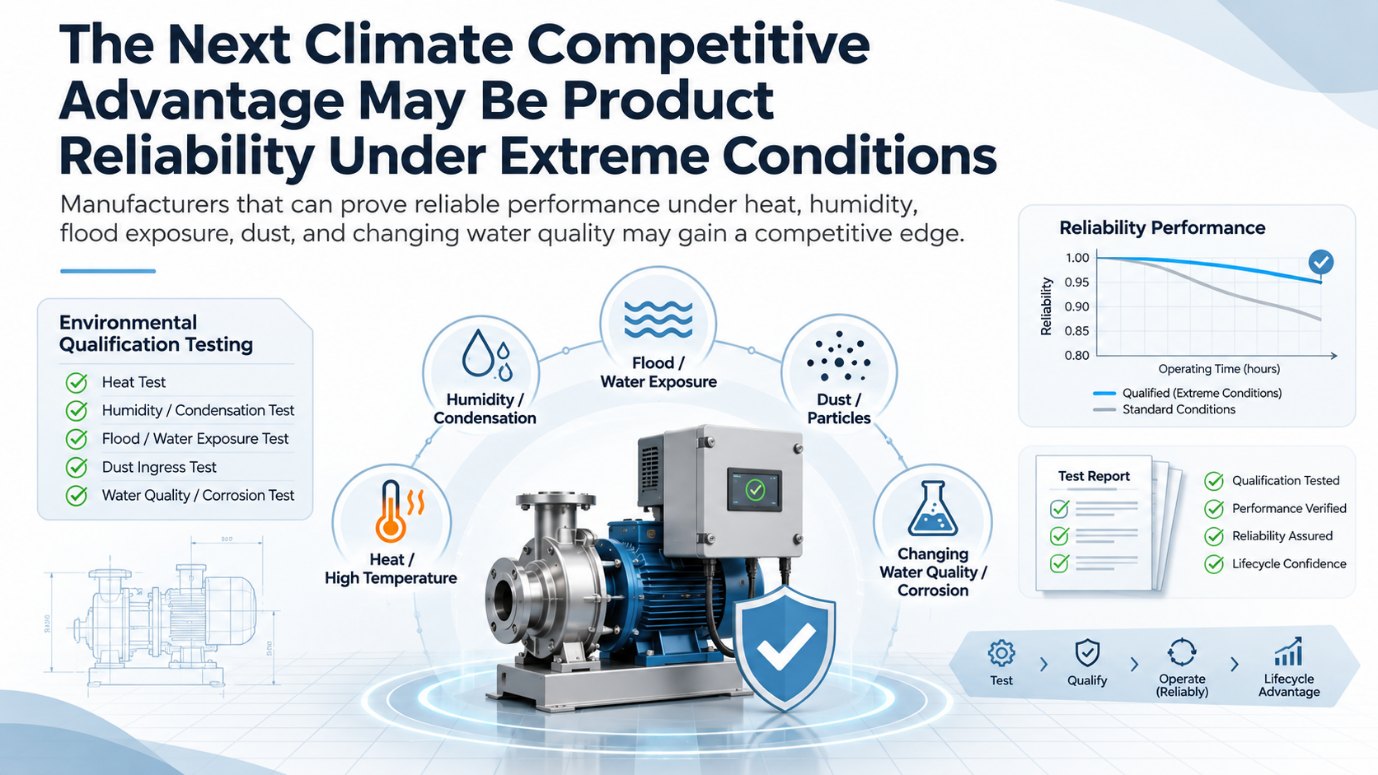
Manufacturers traditionally compete on price, technical specifications, energy efficiency, and total cost of ownership. However, as climate change rapidly accelerates environmental volatility in industrial operating environments, customer priorities are undergoing a fundamental shift toward product survival under extreme conditions—including thermal stress, high humidity, flash flooding, airborne dust, aggressive corrosion, and rapidly shifting water quality.
A critical commercial risk now faces industrial leaders: products are successfully passing standard laboratory tests and meeting original design specifications yet failing in actual deployment because field operating conditions routinely exceed historical validation limits. Whether through electrical thermal stress, pump performance deterioration under changing fluid chemistry, seal and coating breakdown, or enclosure failures during heavy water exposure, static validation is breaking down. Consequently, strategic competitive advantage is pivoting away from unverified claims of resilience toward verified environmental performance under real-world operational stress.
2. Takeaway 1: Generic Resilience Claims Are Out; Verified Envelopes Are In
Vague marketing claims such as "suitable for harsh environments" no longer satisfy industrial customers facing severe environmental stress. Modern customers require precise technical data to evaluate operational risk, system reliability, and true lifecycle costs. Customer specifications must evolve beyond broad assertions to explicitly define expected exposure conditions, operational duration, ambient temperatures, operating loads, cooling arrangements, permissible performance degradation, and clear acceptance criteria.
To meet this demand, forward-thinking manufacturers must establish "Climate-Adjusted Product Operating Envelopes." These documented envelopes establish the precise environmental boundaries within which a product continuously maintains its required performance. Defining these limits requires evaluating temperature extremes, humidity, condensation, dust concentration, water ingress, corrosion exposure, fluid chemistry, and exposure duration—differentiating between continuous operations, temporary extreme events, storage, transportation, and post-event recovery. Frameworks such as ISO 14091:2021 guide climate-related risk assessments, while ISO 14090:2019 helps integrate adaptation into organizational decision-making. As industrial procurement shifts toward empirical validation, strategic leaders recognize that:
The opportunity is to move from selling products with claimed resilience to supplying products with verified environmental performance.
Providing transparent, verified operating envelopes builds buyer confidence, mitigates commercial risk, and equips customers to make rigorous lifecycle evaluations based on validated engineering limits rather than speculative marketing claims.
3. Takeaway 2: Passing Standard Tests Does Not Guarantee Survival
Conventional product qualification heavily relies on isolated, single-variable historical testing. Established standard methods—such as IEC 60068-2-2:2025 (dry heat), IEC 60068-2-78:2025 (steady-state damp heat without condensation), IEC 60068-2-30:2025 (cyclic damp heat with condensation), and IEC 60529 (ingress protection classifications)—provide baseline reference points, but they routinely fail to simulate combined environmental stresses present in field operations.
In operational environments, stress factors act simultaneously: elevated heat accelerates material ageing, high humidity degrades electrical insulation, dust accumulation blocks cooling airflow, and aggressive fluid chemistry accelerates component corrosion. To uncover these vulnerability vectors, engineering teams must deploy Failure Mode and Effects Analysis (FMEA) under IEC 60812:2018 and utilize accelerated testing techniques guided by IEC 62506:2023. However, engineering and commercial teams must heed a vital qualification caveat: accelerated test results must not be translated into service-life guarantees without justified acceleration models and supporting empirical evidence. Physical survival after an isolated test is meaningless if product functionality, efficiency, or overall operating life degrades when exposed to simultaneous real-world environmental stress.
4. Takeaway 3: Over-Promising Resilience is a Commercial Liability
Offering blanket promises or unrestricted warranties in an era of severe, unpredictable climate events creates substantial commercial and legal exposure. Manufacturers must align their commercial commitments, warranties, and Service Level Agreements (SLAs) directly with verified operating envelopes and validated engineering constraints.
Contracts and lifecycle service agreements should explicitly define covered environmental parameters, permitted operating limits, installation criteria, maintenance obligations, inspection intervals, condition monitoring protocols, and applicable contractual remedies. Furthermore, warranty provisions must be systematically reviewed against applicable product safety, consumer protection, and contract law to prevent unquantified liability exposure.
A credible performance guarantee is based on verified operating conditions—not an unrestricted promise that a product will withstand every extreme event.
Establishing strict environmental boundaries does not diminish commercial appeal; rather, grounding guarantees in verified engineering capabilities strengthens customer trust, protects operating margins, and sets transparent performance expectations.
5. Takeaway 4: Product Qualification Must Continue Long After the Sale
Product qualification can no longer be treated as a static milestone completed prior to market release. To sustain long-term market competitiveness, organizations must maintain a "Traceable Product Reliability Evidence" system that systematically bridges initial design assumptions with real-world operational evidence.
This evidence chain moves progressively from initial hypothesis to empirical field validation:
Environmental Exposure → Design Requirements → Qualification Testing → Performance Verification → Failure Analysis → Corrective Actions → Field Validation → Reliability Review
Each link in this progression must be validated by tracking specific indicators, including failure frequency, efficiency degradation, maintenance demand, component deterioration, and operating-limit exceedances. Crucially, reliability predictions must explicitly state their underlying assumptions, uncertainty margins, operating boundaries, and supporting test or field data. This rigor enables manufacturers to clearly distinguish demonstrated past performance from estimated future reliability. By constructing a continuous feedback loop that integrates real-time field monitoring, component inspections, customer complaints, maintenance records, and warranty claims, manufacturers convert operational experience into a dynamic engine for continuous product improvement.
6. Takeaway 5: Climate Adaptation Belongs in the R&D Lab, Not Just Factory Operations
Climate risk has historically been miscategorized as an operational challenge restricted to facility defence, infrastructure protection, or supply-chain logistics. However, true operational resilience requires integrating climate adaptation directly into early-stage product development, materials selection, procurement specifications, qualification testing, and long-term service commitments.
This strategic pivot is vital across critical equipment categories, including electrical systems, industrial machinery, pumps, water treatment systems, construction products, and cooling equipment. Without early R&D integration, thermal stress degrades electrical controls, changing fluid conditions impair pump performance, protective coatings and seals break down prematurely, and enclosures fail underwater immersion. Market leadership will no longer belong to manufacturers that qualify products against historical weather patterns, but to visionary organizations that actively design equipment for the environmental realities of tomorrow.
7. Conclusion: The New Frontier of Quality Assurance
Achieving true climate resilience requires moving beyond basic regulatory compliance and standard single-variable testing. It demands an integrated operational framework that combines sound engineering design, representative multi-stress qualification, transparent operating envelopes, traceable reliability evidence, and continuous field validation.
As environmental volatility accelerates globally, industrial leaders must fundamentally re-examine their product development and quality assurance strategies:
Is your organization qualifying products against historical environmental conditions, or verifying their performance against the operating conditions customers may face in the future?