 METRIQOm®
Why Your Mosquito Control Strategy Is Already Obsolete: The Hidden Climate Vulnerability in Public Health
The Invisible Flaw in Traditional Public Health
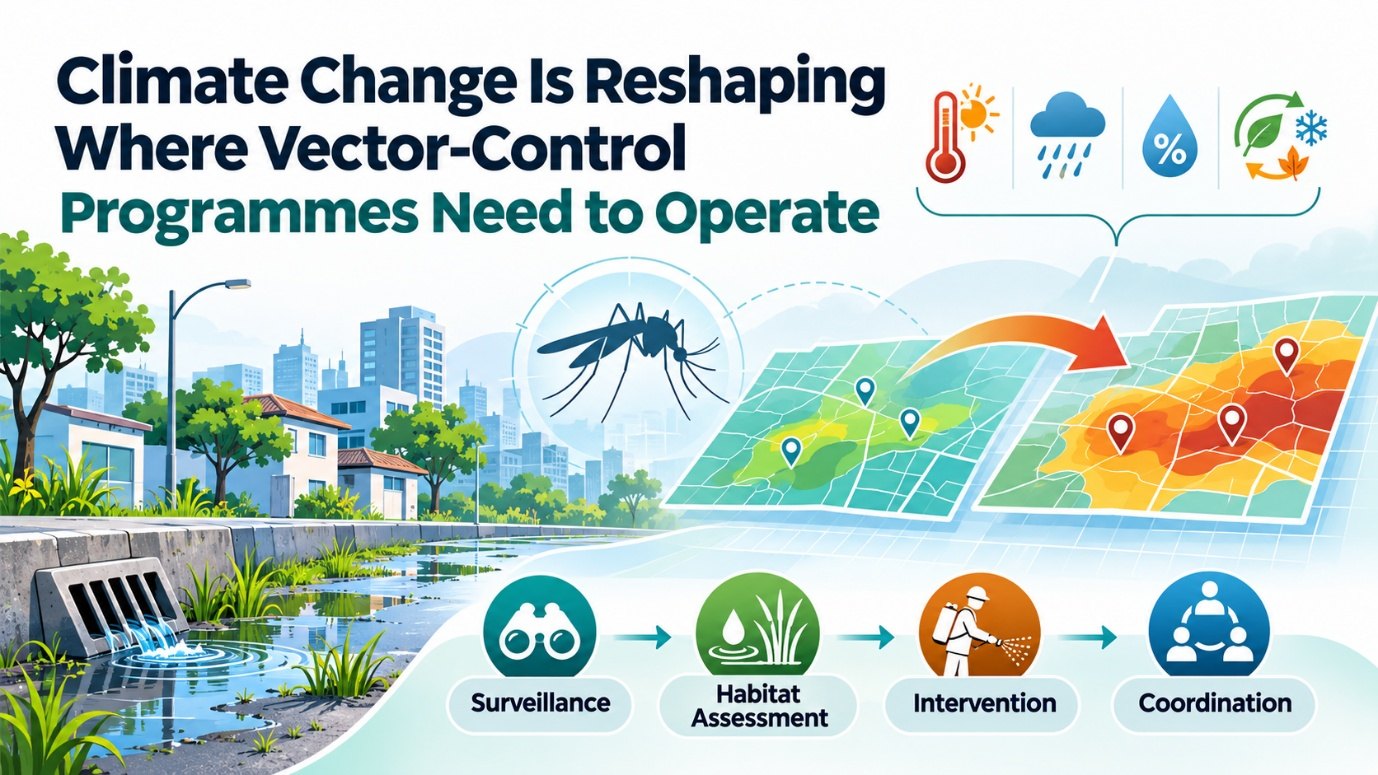
A mosquito-control program can complete every single scheduled inspection and still completely miss where the next public-health risk is emerging. This counter-intuitive flaw exposes a critical vulnerability in modern public health infrastructure. As climate change accelerates, shifting temperatures, erratic rainfall patterns, fluctuating humidity, and changing water availability dynamically alter mosquito breeding habitats, survival rates, geographical distribution, and seasonal activity. Depending on the vector species, local environmental conditions, and disease epidemiology, these environmental shifts can expand or relocate vector threats in real time. Because historical risk zones are no longer static, rigid, calendar-based control plans have become obsolete. To protect communities effectively, public health policy and vector control must transition to a surveillance-led, geographically adaptive strategy.
The Trap of Static Control Plans: Why Traditional Vector Control Fails
Many public health agencies and facility control programs remain locked into static, historical routines. They rely heavily on fixed inspection routes, seasonal treatment schedules, outdated breeding-site inventories, and reactive public complaints to dictate where and when field crews deploy. Under volatile climate conditions, this operational model creates dangerous blind spots.
Changing rainfall patterns and sudden stormwater accumulation frequently generate new breeding habitats in unexpected municipal sectors. Simultaneously, evolving civil environments—such as ongoing infrastructure construction, shifting agricultural irrigation systems, and urban development—create immediate, unmapped vector risks. Counterintuitively, drought conditions also elevate vector threats. When municipal water shortages strike, residents often resort to informal rainwater harvesting or emergency water storage. When these storage containers are inadequately sealed or managed, they transform urban neighborhoods into explosive container-breeding hubs for vectors like Aedes mosquitoes.
Relying on traditional output metrics creates a dangerous illusion of security. Completing every scheduled task on a calendar does not mean emerging public health risks are actually being identified or managed. When environmental conditions shift, fixed inspection routes merely guarantee that vector control teams spend time where risks used to be, rather than where active threats are currently emerging.
The New Operational Control Chain: Moving Beyond Reactive Spraying
To keep pace with climate-driven vector dynamics, public health programs must move past reactive chemical spraying and rigid calendars. Control operations must adopt a structured, climate-adapted operational sequence:
Climate Monitoring → Habitat Assessment → Vector Surveillance → Risk Classification → Intervention → Effectiveness Verification → Public-Health Coordination
Traditional vector control often operates from the bottom of this chain upward—reacting only after public complaints accumulate or predefined calendar dates arrive. This forces operations into a perpetual reactive loop, spending taxpayer and facility budgets on chemical interventions before verifying actual risk.
By contrast, placing Climate Monitoring and Habitat Assessment at the very top of the operational chain ensures that vector surveillance and subsequent interventions are driven by real-time predictive environmental data. Teams identify micro-climate shifts and physical site vulnerabilities before vector populations surge. Interventions are authorized only after proper risk classification, and they are immediately validated through post-treatment effectiveness verification and cross-sector communication.
Seven Technical Solutions for Modern Vector Adaptation
Transitioning to a climate-adapted vector control program requires an integrated technical toolkit. Modern public health frameworks demand seven core operational solutions:
- Dynamic Risk Mapping: Combine Geographic Information Systems (GIS), real-time climate data, municipal drainage infrastructure records, and vector-surveillance findings to continuously update geographic inspection priorities. This process explicitly distinguishes land that merely presents a suitable physical habitat from areas with confirmed vector presence or active disease transmission.
- Integrated Surveillance: Monitor mosquito species composition, population abundance, breeding activity, and relevant pathogen indicators side-by-side with localized environmental conditions to spot emerging threats early.
- Risk-Based Intervention: Establish locally validated operational triggers, explicit agency responsibilities, and standardized escalation procedures based on vector activity, disease surveillance, and surrounding population exposure.
- Habitat and Infrastructure Control: Embed breeding-site elimination directly into civil and facility maintenance—including drainage management, irrigation oversight, and construction site monitoring—while applying authorized, targeted chemical or biological treatments only where justified.
- Cross-Sector Coordination: Connect municipal surveillance systems, healthcare reporting networks, and site-level physical inspections using defined responsibilities, shared protocols, and clear escalation channels. For instance, municipal public works departments must share real-time civil maintenance and drainage failure data directly with vector control teams to remediate standing water hazards before breeding cycles complete.
- Effectiveness Verification: Shift primary evaluation focus away from superficial operational counts toward verified health outcomes—such as measurable breeding-site reduction, lower mosquito abundance, and diminished residual risk.
- Adaptive Resource Allocation: Continually evaluate surveillance coverage, operational response times, unresolved habitats, and intervention success rates to dynamically reallocate staffing, financial budgets, and geographic deployment.
These seven technical solutions align directly with leading international and national reference frameworks, including the World Health Organization (WHO) Global Vector Control Response and the U.S. Centers for Disease Control and Prevention (CDC) Integrated Mosquito Management framework.
Measuring Outcomes, Not Just Activity: Verifying Real-World Impact
A fundamental requirement of climate-adapted vector control is changing how public health leaders evaluate success. Traditional program management frequently relies on output metrics:
- The total number of routine inspections completed.
- The total volume or gallons of chemical treatments applied across a district.
While these figures quantify operational activity, they fail to demonstrate safety, efficacy, or risk reduction. Modern vector control requires rigorous effectiveness verification grounded in public health outcomes. Programs must verify whether intervention efforts resulted in an actual reduction of active breeding sites, a measurable drop in local mosquito abundance, and a concrete decrease in residual disease risk. Operational success must be defined by the elimination of vector threats, not the sheer volume of work performed.
The Leadership Decision & Final Reflection
Navigating the realities of climate change requires a decisive shift in public policy and operational leadership. Vector control can no longer function as a passive, calendar-driven maintenance task; it must operate as a surveillance-led, geographically adaptive public health strategy. For municipalities, healthcare networks, industrial parks, construction enterprises, and facility managers, adapting to climate risks means systematically linking shifting environmental conditions to verified vector presence, civil infrastructure controls, clear response authorities, and measurable outcomes.
Public health decision-makers must evaluate their current operational posture against a fundamental question:
Are your vector-control resources deployed where mosquitoes were historically expected—or where current evidence shows that risks may be emerging?
Re-examining your organization's climate adaptation strategy today is the only way to ensure vector-control operations remain resilient, targeted, and capable of protecting public health in an increasingly unpredictable world.