The HSE Tool helps you manage operational risk in a more structured and disciplined way by integrating incident management, inspections, audits, risk assessments, corrective actions, competency records, and performance indicators. It functions as a control platform for reducing incidents, improving discipline, and strengthening management visibility across safety, health, quality, and wider operational assurance.
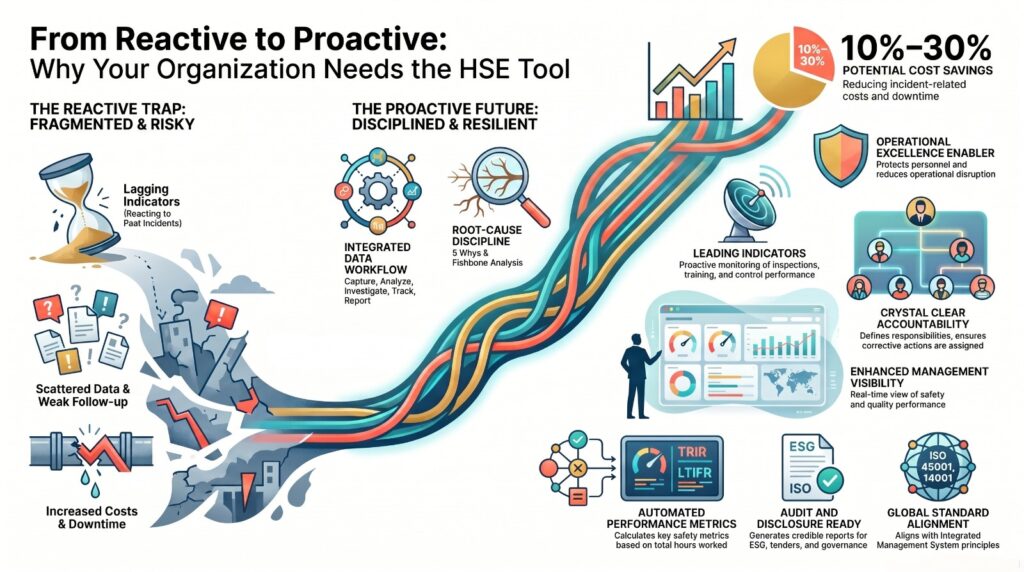
The tool allows you to capture and analyze incidents, near misses, unsafe conditions, inspection findings, audit results, and corrective actions in one workflow. It can support root-cause investigation methods such as 5 Whys and fishbone analysis, while also tracking total hours worked so metrics such as TRIR and LTIFR can be calculated and fed into ESG reporting. This is important because organizations increasingly need safety data not only for internal management, but also for disclosures, client tenders, and governance reviews.
The benefit to you is clear. It supports better risk prevention, stronger follow-up, clearer accountability, and more credible reporting. It also helps management move from lagging indicators alone toward a stronger mix of leading indicators such as inspections, training, action closure, and control performance.
This tool is an operational excellence enabler. It helps you protect people, reduce disruption, demonstrate stronger contractor and site control, and build a more audit-ready and disclosure-ready risk management environment.
Benefits
Can reduce incident-related cost and downtime, with prevention and risk-cost avoidance potential of up to 10–30% where controls are weak.
Methodology
Risk-based management using likelihood × severity scoring, incident investigation methods such as 5 Whys and fishbone analysis, action tracking, KPI monitoring, audit and inspection workflows, and alignment with ISO 45001 and integrated management system principles. Standards/frameworks: ISO 45001, ISO 9001, ISO 14001, ISO 19011.