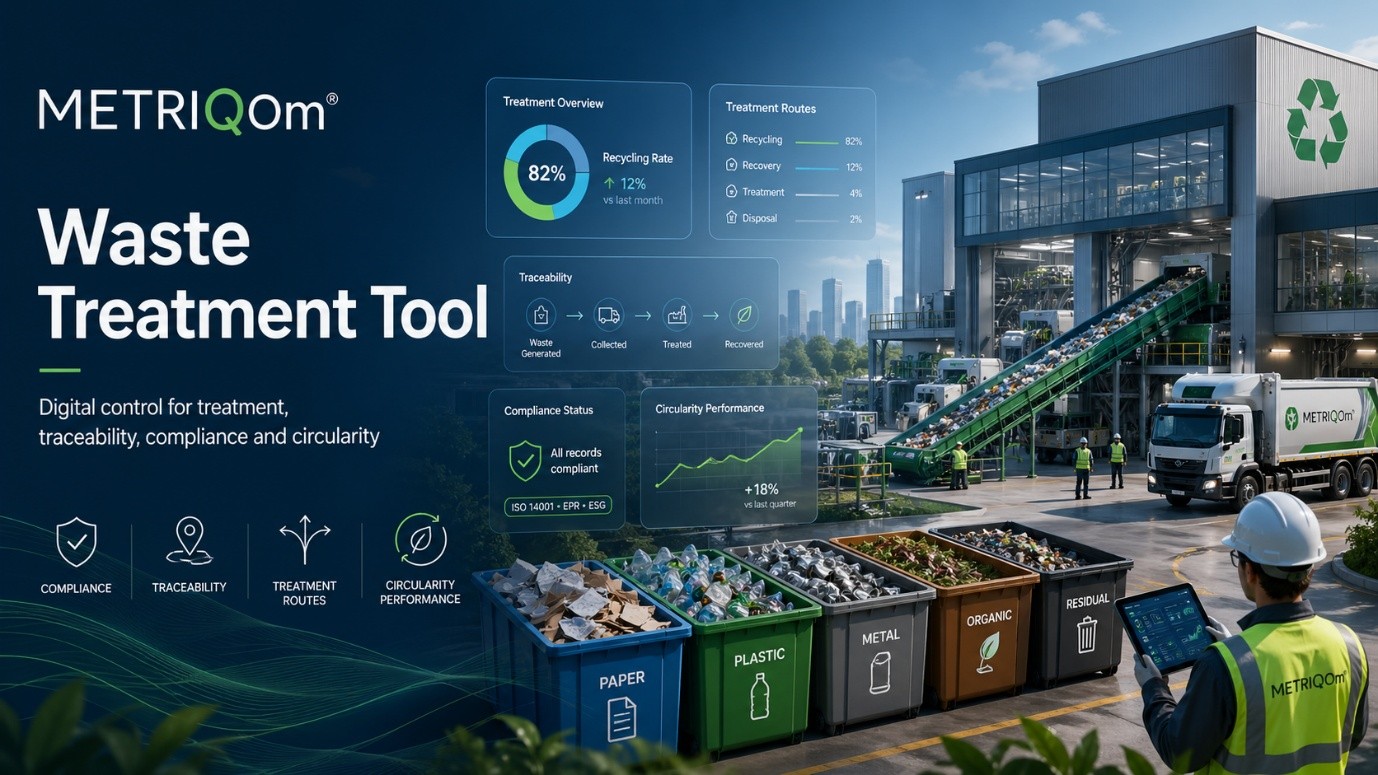
Waste treatment is no longer a simple operational task handled at the end of a process. For modern companies, waste treatment affects environmental compliance, cost control, carbon performance, circular economy targets, client expectations, and ESG reporting.
Many organisations still manage waste through scattered spreadsheets, contractor invoices, weighbridge slips, disposal manifests, and monthly summaries. That may be enough to show that waste was collected, but it is not enough to prove that waste was properly classified, treated, diverted, recovered, or controlled.
This is where the METRIQOm® Waste Treatment Tool changes the operating model.
It transforms waste management from a reactive disposal activity into a structured, evidence-based, and performance-driven control system.
The Problem: Waste Data Is Often Fragmented
In many facilities, construction projects, industrial sites, and real estate portfolios, waste information is spread across multiple sources:
Waste logs are kept by site teams. Contractor tickets are stored separately. Hazardous waste manifests may sit with the HSE or environmental team. Finance has cost records. ESG teams receive monthly totals. Management sees only a high-level recycling percentage.
This creates several problems:
- Weak traceability
It becomes difficult to prove where waste came from, how it was classified, who handled it, and where it finally went. - Poor treatment visibility
Companies may know the waste quantity, but not whether it was reused, recycled, treated, recovered, landfilled, or disposed of through a controlled hazardous waste pathway. - Compliance exposure
Incorrect classification, missing permits, poor contractor documentation, or incomplete manifests can create regulatory and client risks. - Lost cost-saving opportunities
Waste is often treated as a disposal cost, not as a material-loss signal or circular economy opportunity. - Weak ESG reporting confidence
If waste data is not structured, validated, and supported by evidence, ESG and sustainability disclosures become difficult to defend.
What the METRIQOm® Waste Treatment Tool Does
The METRIQOm® Waste Treatment Tool provides a structured digital workflow for managing waste from generation to final treatment.
It helps organisations capture, classify, validate, monitor, and report waste data across projects, sites, assets, departments, and contractors.
The tool is designed to answer practical operational questions:
- What type of waste was generated?
- Where did it come from?
- Is it hazardous or non-hazardous?
- Which contractor handled it?
- Was the contractor approved and permitted?
- What treatment route was used?
- Was the waste recycled, recovered, reused, treated, landfilled, or disposed?
- What evidence supports the record?
- What is the cost, intensity, and environmental performance?
- What can be improved next month?
From Waste Tracking to Waste Treatment Intelligence
Basic waste tracking tells you how much waste was removed.
Waste treatment intelligence tells you whether the waste was managed correctly, efficiently, and in line with business objectives.
METRIQOm® connects waste data with treatment outcomes, compliance records, cost indicators, circularity performance, and ESG reporting needs.
This helps companies move from:
“How much waste did we dispose of?”
to:
“How much waste did we prevent, reuse, recycle, recover, treat, or lose to landfill — and what does that mean for cost, compliance, and ESG performance?”
That shift is critical.
Key Capabilities of the Waste Treatment Tool
1. Waste Classification and Source Tracking
The tool allows each waste stream to be classified by source, type, material, hazard status, treatment route, and responsible site or business unit.
This is especially important for construction, manufacturing, facility management, infrastructure, and industrial operations where waste streams can include:
- General waste
- Construction and demolition waste
- Concrete, asphalt, timber, metals, plastics, packaging, gypsum, insulation, and glass
- Excavated material
- Contaminated soil
- Sludge and wastewater treatment residues
- Used oil and oily waste
- Chemical waste
- E-waste
- Batteries and lamps
- Food and organic waste
- Hazardous and special waste streams
Each waste stream becomes part of a controlled data model, not just a monthly total.
2. Treatment Route Control
The tool tracks how each waste stream is managed after generation.
Treatment routes can include:
- Prevention
- Reuse
- Internal reuse
- Recycling
- Material recovery
- Energy recovery
- Biological treatment
- Chemical treatment
- Physical treatment
- Stabilisation or solidification
- Composting
- Wastewater treatment
- Hazardous waste treatment
- Landfill
- Controlled disposal
This gives management a clearer view of whether the organisation is moving up the waste hierarchy or still relying heavily on disposal.
3. Contractor and Facility Verification
Waste treatment is only as reliable as the contractor and receiving facility behind it.
METRIQOm® helps link waste records to approved contractors, transporters, treatment facilities, permits, licenses, manifests, and evidence documents.
This supports stronger governance over:
- Contractor approval status
- Permit validity
- Treatment facility acceptance
- Transport documentation
- Manifest completeness
- Evidence upload and review
- Non-conformance follow-up
This is not just an administrative feature. It is a risk-control mechanism.
4. Evidence-Based Compliance
Waste compliance fails when records cannot be proven.
The tool supports evidence capture for each waste movement or treatment record, including weighbridge tickets, collection notes, invoices, manifests, photographs, permits, laboratory results, treatment certificates, recycling certificates, and disposal confirmation.
This creates an audit-ready trail that can support internal reviews, client audits, authority inspections, ESG assurance, and corporate reporting.
5. Waste Performance Dashboards
METRIQOm® converts waste data into decision-ready dashboards.
Typical indicators may include:
- Total waste generated
- Waste by site, project, department, or asset
- Waste by stream and material type
- Hazardous vs non-hazardous waste
- Recycled, reused, recovered, treated, and landfilled quantities
- Diversion rate
- Landfill dependency
- Waste intensity per revenue, production unit, floor area, project value, or working hour
- Contractor performance
- Treatment cost per tonne
- High-risk waste streams
- Missing evidence or overdue documentation
- Monthly trends and abnormal increases
This helps teams move from reporting historical data to managing performance proactively.
Why Waste Treatment Matters for ESG and CSRD Reporting
Waste is directly connected to environmental performance, resource efficiency, circular economy, pollution prevention, and value-chain responsibility.
For companies preparing ESG reports, CSRD-aligned disclosures, GRI reporting, client sustainability submissions, or internal executive dashboards, waste treatment data must be structured and defensible.
The METRIQOm® Waste Treatment Tool helps create the foundation for reliable reporting by connecting operational waste records to:
- Circular economy indicators
- Pollution prevention controls
- Resource efficiency metrics
- Waste diversion and recovery performance
- Hazardous waste management
- Contractor and supply-chain oversight
- Evidence registers
- Audit trails
- Management review dashboards
Instead of collecting waste figures at the end of the year, the tool builds reporting readiness into daily operations.
Circular Economy Starts With Better Waste Data
Circular economy is not achieved by slogans. It starts with knowing what materials are being lost, where they are being lost, and whether they can be reused, substituted, segregated, recovered, or redesigned out of the process.
METRIQOm® helps companies identify practical circular economy opportunities, such as:
- Improving waste segregation at source
- Reducing contamination of recyclable materials
- Reusing excavated materials where permitted
- Recovering metals, timber, plastics, and packaging
- Reducing packaging waste from suppliers
- Improving procurement specifications
- Tracking recycled-content opportunities
- Reducing disposal cost through better treatment routing
- Identifying sites with abnormal waste intensity
This makes circularity measurable, operational, and commercially relevant.
Waste Treatment as a Cost-Control Opportunity
Waste is often a hidden cost centre.
The visible cost is disposal. The hidden costs include poor segregation, double handling, rejected loads, contamination, over-ordering of materials, inefficient procurement, storage losses, non-compliance penalties, and missed recycling revenue.
By linking waste quantity, treatment route, contractor, site, and cost, METRIQOm® helps organisations identify where waste is financially damaging performance.
The question becomes:
Are we paying to dispose of materials that should never have become waste in the first place?
That is where operational savings begin.
Designed for Real Operations
The METRIQOm® Waste Treatment Tool is built for practical use across complex organisations.
It can support:
- Construction companies
- Real estate owners and developers
- Industrial facilities
- Manufacturing companies
- Facility management providers
- Infrastructure projects
- Logistics operations
- Waste-generating service businesses
- Multi-site corporate groups
The tool supports site-level data entry while giving management group-level visibility. This allows operational teams to manage day-to-day records while leadership monitors risk, cost, and ESG performance from a central dashboard.
Integration With the METRIQOm® Control Tower
The Waste Treatment Tool does not operate in isolation.
It connects with the wider METRIQOm® platform, including:
- ESG & CSRD Mapping and Reporting Tool for disclosure alignment
- GHG & Carbon Footprint Tool for waste-related emissions tracking
- Environmental Compliance Tool for permit and regulatory controls
- Supply Chain and Contractor Prequalification Tool for vendor oversight
- Chemical Storage and Safety Tool for hazardous waste linkages
- Water Management Tool for sludge, wastewater, and treatment residues
- QHSSE Tool for incidents, inspections, corrective actions, and audits
This integrated model reduces duplication. One structured waste record can support compliance, ESG reporting, carbon accounting, contractor management, cost review, and executive dashboards.
The Business Value
The METRIQOm® Waste Treatment Tool helps organisations create measurable value by improving:
- Compliance control
- Evidence readiness
- Contractor accountability
- Waste segregation
- Recycling and recovery performance
- Circular economy tracking
- Cost visibility
- ESG and CSRD reporting confidence
- Audit preparedness
- Management decision-making
The result is not just better waste reporting.
The result is better waste governance.
Final Thought
Waste treatment is not the end of the operational chain. It is a signal of how efficiently a business manages materials, contractors, compliance, and environmental responsibility.
Companies that control waste treatment properly can reduce costs, improve circularity, lower compliance exposure, strengthen ESG performance, and build a more resilient operating model.
The METRIQOm® Waste Treatment Tool gives organisations the structure, visibility, and evidence needed to move from waste disposal tracking to intelligent waste treatment management.
METRIQOm® turns waste data into operational control, ESG confidence, and circular economy action