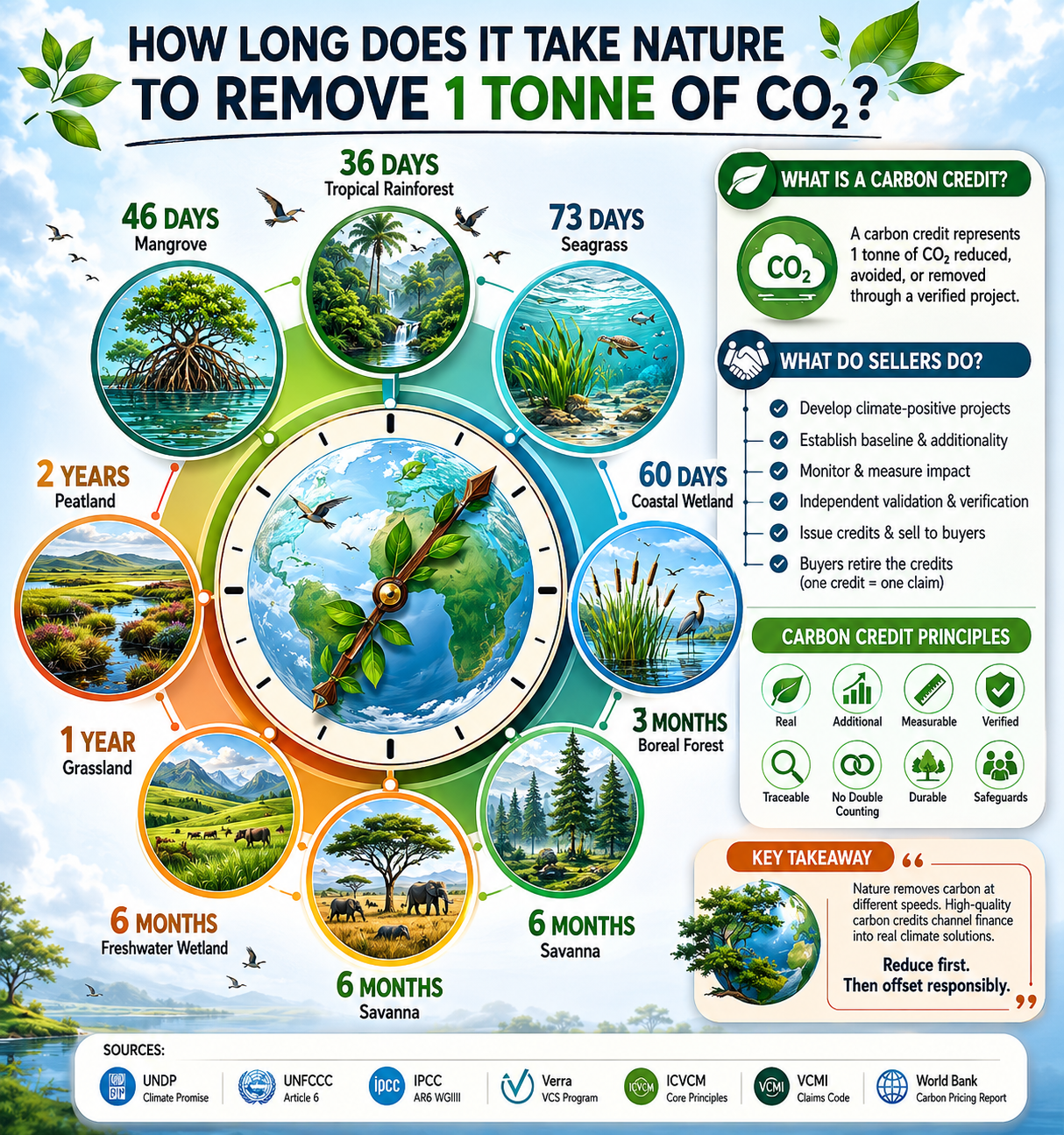
1. The Foundations: What is a Carbon Credit?
To understand the global effort to stabilize our climate, we must first define the unit of exchange. Today, carbon pricing and crediting markets have expanded to cover nearly 30% of global greenhouse gas emissions. This growth is supported by frameworks like the UNFCCC’s Article 6, which allows countries to cooperate and transfer mitigation outcomes to meet international climate targets.
Key Concept: The Carbon Credit A carbon credit is a tradable unit representing one tonne of carbon dioxide equivalent (CO2e) that has been reduced, avoided, or removed from the atmosphere through a verified project.
The Mitigation Hierarchy
A common misconception is that purchasing credits provides a “license to pollute.” In a rigorous climate curriculum, credits are the final step, not the first. Organizations must follow the Mitigation Hierarchy:
- Measure: Quantify all emissions (Scope 1, 2, and relevant Scope 3).
- Reduce: Implement operational changes to eliminate emissions at the source.
- Credit: Purchase and retire high-quality credits only for residual emissions—those final, hard-to-abate tonnes that remain after all feasible reduction efforts are exhausted.
While a credit represents a standardized financial unit, it is rooted in a physical reality: the varying speeds at which different ecosystems capture carbon.
——————————————————————————–
2. The “Carbon Clock” Concept: Why Timing Isn’t Universal
The “Carbon Credit Clock” is a pedagogical metaphor used to visualize sequestration speed. While a clock implies a steady tick, the rate at which nature “earns” a credit is highly variable.
| The Simple Narrative | The Scientific Reality |
| Carbon credits take a fixed, universal amount of time (e.g., “exactly 2 years”) to generate. | Sequestration rates are determined by specific Methodologies, Locations, and Baselines. A “vintage year” marks when the benefit actually occurred. |
| One hectare of any nature-based project works at a constant speed. | Different ecosystems have different “clocks.” Coastal systems may capture carbon faster, while peatlands accumulate it over centuries. |
| A clock tells you the universal “market speed” of carbon. | Timing is an educational illustration; actual climate impact must be independently verified for every unique project site. |
Speed vs. Durability Learners must distinguish between the speed of capture and the duration of storage. Captured carbon is stored in various reservoirs: terrestrial (plants/soil), ocean, geological, or even product reservoirs (such as harvested wood or carbon-captured materials). The goal of high-quality crediting is to move toward durable storage, ensuring the carbon does not return to the atmosphere shortly after the credit is issued.
——————————————————————————–
3. Ecosystem Profiles: Comparing Sequestration Mechanics
Different ecosystems utilize different “carbon pools.” Understanding these mechanics helps us evaluate the risk and reliability of a project’s “clock.”
- Mangroves and Seagrasses: These “blue carbon” systems are highly efficient, sequestering carbon rapidly into sediments. Their capture rate is often faster than terrestrial forests per unit of area.
- Peatlands and Wetlands: These are the planet’s long-term vaults. While they may accumulate carbon slowly, they hold massive volumes in their organic soil. Protecting them is vital because their “clock” represents thousands of years of stored carbon.
- Forests and Tropical Ecosystems: These projects primarily store carbon in above-ground biomass (trunks and leaves). While they offer significant removal potential, this biomass is vulnerable to immediate release through fire or logging.
- Grasslands: These systems store carbon primarily in the soil. Because this carbon is stored underground, these reservoirs are often less susceptible to risks like fire compared to the above-ground biomass of forests, making their “clock” more resilient over time.
——————————————————————————–
4. Decoding the Impact: The Four Critical Variables
Two projects may appear identical, but their integrity hinges on variables that determine if a “tonne” is truly a “tonne.”
- Baseline (The “What If” Factor): This is the hypothetical scenario of what would have happened without the project.
- Learner’s Question: “If this forest was already protected by law, does my purchase actually result in Additionality, or was the benefit going to happen anyway?”
- Location and Climate: Environmental conditions dictate biological speed.
- Learner’s Question: “How do local rainfall, temperature, and soil health specifically impact the sequestration rate of this project compared to the regional average?”
- Soil Condition and Carbon Pool: Identifying which “pool” is being measured is vital for risk assessment.
- Learner’s Question: “Is the credit based on biomass (leaves/wood) or soil/sediment, and how does that change the permanence of the storage?”
- Permanence and the “Risk Buffer”: This addresses the risk of the carbon being released back into the atmosphere.
- Learner’s Question: “If a forest fire occurs, what happens to the integrity of my climate claim?”
The Risk Buffer as a “Savings Account”: To protect the “clock,” high-quality projects do not sell 100% of the credits they generate. Instead, they contribute a portion into a Risk Buffer—essentially a communal savings account of credits. If one project suffers a “reversal” (like a fire), credits from the buffer are canceled to ensure the atmosphere is still “whole” and the buyer’s claim remains honest.
——————————————————————————–
5. The Integrity Checklist: Beyond the Claims
To move from scientific variables to formal climate claims, projects must be audited against international standards (like ICVCM and VCMI) and recorded on a public registry.
- [ ] Real: There is physical evidence of a climate benefit, backed by a verification report.
- [ ] Additional: The project was only possible because of the carbon finance provided.
- [ ] Measurable: Calculations use approved, science-based methodologies to count CO2e.
- [ ] Verified: An independent third party (e.g., Verra) has audited the project and its data.
- [ ] Traceable: The credit has a unique serial number and a specific vintage year on a registry.
- [ ] Social/Biodiversity Safeguards: The project protects local communities and native species.
- [ ] Retired (The Seller-Buyer Handshake): To prevent double-counting, the Seller must maintain the registry record, while the Buyer must officially “retire” the credit. Retirement takes the credit out of circulation permanently, ensuring that the same tonne of CO2e cannot be claimed by any other entity.
——————————————————————————–
6. Summary: Data Over Attractive Claims
Carbon credits are a sophisticated financing mechanism, not a magic wand. They are a tool for channeling capital toward climate solutions that would otherwise lack the necessary funding.
“Nature can help remove carbon, but nature needs time, space, protection, and credible measurement. The future of carbon markets will not be built on attractive claims; it will be built on data, verification, transparency, and real climate impact.”
While the “Carbon Credit Clock” helps us visualize the timing of the natural world, our ultimate responsibility is to ensure that every “tick” of that clock is verified by hard data and protected by rigorous human oversight.